Table of Contents
Report
The most exciting phrase to hear in science, the one that heralds the most discoveries, is not “Eureka!” (I found it!) but “That's funny…” ~Isaac Asimov
Acknowledgement
There are many estimations about how many surfers there are in the world but one of them are 23 million [1]. Many surfers are regular people wanting to ride the waves on their spare time and others are professionals, catching waves for a living. What they both have in comment is the passion and eager to learn and become better. We believe that our product is an opportunity to do just this.
We have analysed existing products and looked for opportunities to stand out among them. Most of the already existing products are only prototypes and much development can be made. This report describes the development process of a surf logging system.
Glossary
| Abbreviation | Description |
|---|---|
| EPS | European Project Semester |
| EU | European Union |
| ISEP | Instituto Superior de Engenharia do Porto |
| GPRS | General Packet Radio Service |
| GPS | Global Positioning System |
| GSM | Global System for Mobile Communication |
| Li-ion | Lithium ion |
| Li-Po | Lithium Polymer |
| NiCd | Nickel–Cadmium |
| NiMH | Nickel–Metal Hydride |
| NiZn | Nickel-Zink |
| RF | Radio Frequency |
| SWOT | Strengths, Weaknesses, Opportunities, and Threats |
| UCSB | University of California San Diego |
| USB | Universal Serial Bus |
1. Introduction
1.1 Presentation
Our group of five people represent different parts of Europe and different cultures. The fact that everyone of us specialise in various areas adds more diversity to our team. Despite the many differences we have taken a common goal, which is the realisation of the project using the skills, experience and knowledge from different disciplines on a common field.

1.2 Motivation
The motivation was a common curiosity about the sport that is not popular in any of our countries, but extremely popular in Porto. Mutual talks about it has led to many questions, many ideas and consequently to choosing the topic “Travel Logging System” in relation to surfing. We would like to create something that you can measure and find out more information about your surfing. This motivates us through the project.
1.3 Problem
Concerning our product we are confronted with the following problems;
Design a waterproofed box.
- The cover of the product have to be waterprofeed to be able to use on the surfboard.
Wireless connection from the box to the Computer with less power consumption.
- With lower power consumption the battery will last longer.
Programm a user-interface
- To make it easy to get the data out from the logger.
Small size and low weight
- This is more for the final product but still something we should considered.
Energy consumption
- We have to reasearch how much the energy consumption is for our components so we can choose a suitable battery.
Compatibility of the several components
- We must make sure all components fits together and runs on the same voltage level.
1.4 Objectives
The main objective is to design and develop a surf logger system that complies with the requirements described in 1.5. To create a product that is easy to use for the normal surfer but still adequate to be useful in surfing competitions.
1.5 Requirements
Develop and design a surf logger device that complies with the following requirements:
- Sensors to measure acceleration and rotation of the surfboard.
- A device with on board data storage or if possible connection with a “cloud”.
- Light, small, portable, wearable device that will not interfere with the balance of the surfboard
- 24 h Power autonomy
- Use open source technologies
- Visualizes the data from the surf logger in real time.
- Temperature sensor to see if the temperature gets to warm.
Comply with the following EU Directives:
- Machine Directive (2006/42/CE 2006-05-17);
- Electrical Safety: Low Level Voltage Directive (2006/95/CE 2006-12-12);
- Restriction of Hazardous Substances (ROHS) in Electrical and Electronic Equipment Directive (2002/95/EC 2003-01-27);
1.6 Functional Tests
To make sure that our sensorbox fulfills all our requirements it has to fulfill some specific functional tests. There are the follwing test;
- Checking the Bluetooth connection
- Recording data from the sensors and show them on a monitor
- Testing the battery time
- Switching the on/off button, is it effortless?
- Testing the device in water
1.7 Project Planning
We created a Gantt chart to give us a good overview of our project. We also created a task list to assign specific tasks to specific team members depending on what they preferred and their previous knowledge.
1.8 Report Structure
This report is structured in seven chapters.
The first chapter is the Introduction and presents the problem, the motivation, the objectives, the requirements, functional tests and project planning.
The second chapter is the State of The Art and presents a general view of similar products in this area. It also presents technologies we used to create our product.
The third chapter is the Marketing Plan and presents market environment analysis, SWOT (Strengths, Weaknesses, Opportunities, and Threats) analysis, market segmentation, marketing targeting and positioning, marketing mix, use of advertisment budget and conclusion.
The fourth chapter is the Eco-efficiency Measures for Sustainability and presents what is a sustainable product, what kind of materials we are going to use and how they influence the environmental, social and economic life.
The fifth chapter presents our Ethical and Deontological Concerns for the project.
The sixth chapter is the Project Development. It presents the materials used, the system architecture, modules used, functionalities and the final test requirements.
The seventh chapter includes our conclusion of the project as well as suggestions for future developments.
After conclusion it is the bibliography and appendixes
2. State of the Art
2.1 Introduction
A Surf Logger is a device useful for surfers, which allows to measure the rotation and acceleration of surfboard. These data are saved and sent to visualise movement of surfboard on the monitor in real time. Use of Surf Logger enables to track and register surfing. Thanks to this it is possible to analyse style and techniques of surfer which can be useful during learning or competitions.
To do that we will use an inertial measurement unit, or IMU, is an electronic device that measures and reports on a craft's velocity, orientation, and gravitational forces, using a combination of accelerometers and gyroscopes, and occasionally magnetometers.
In this section we will present similar products that are already existing on the market. We will also make a comparison of the available technologies and components in order to select those that will be the most suitable for the Surf Logger. We will consider aspects of energy consumption, efficient working of sensors, the correctness of storage and sending data and structure of the device with case.
2.2 Related Projects and Products
There are a number of competitors in the data logging industry. We have studied different kind of sensor boxes that compiles with our own.
Android Sensor Box
Android box is a tool that you can implement in your Android device. It uses many different sensors that can be used in your daily life with a click off a button. The device only detects changes. It may not show the correct temperature, proximity, light and pressure values if no changes occur. For better performances, sensors are usually used together [1].
Twine sensor box
Twine is a wireless sensor block tightly integrated with a cloud-based service. The durable, rubbery block has Wi-Fi, on-board temperature and orientation sensors, and an expansion connector for other sensors. The additional sensors can for instants detect floods, leaks, opened doors, and signals from your other home systems. Power is supplied by micro USB or two AAA batteries. By using web app makes it simple to set up and monitor your Twines from a browser. The Twine concentrates on to alert you to small problems before they become big problems [2].
Sensor-packed SurfSens
The research company Tecnalia and Spanish surfboard manufacturer Pukas have teamed up to create a surfboard that packs a gyroscope, accelerometer, GPS compass, pressure sensors and strain gauges to measure the flex of the board. Last year, four students from the University of California, San Diego, installed a computer and series of sensors on a surfboard with the goal of designing the “perfect” board. Being a student effort, the UCSD board wasn't as refined as the board created by Pukas and Tecnalia, which contains all the electronics within the board itself. The idea of the product is for professional riders to improve their styles using the data collected [3].
Push Snowboarding (Nokia and Burton)
Nokia, a company incorporating wearable sensors into snowboarding, witch communicates with a smartphone through Bluetooth in real-time. With Nokia’s smartphone’s as a platform for capturing and analysing data, the mobile application uses the phone’s GPS capabilities along with the data collected from four sensors implemented in the snowboard to provide snowboarders with live tracking of their ride including speed, heart rate, airtime, rotation and a measure of how excited a rider was while snowboarding [4].
2.3 Technologies
In this chapter we will explain the diffrent technologies we chose to use in our project. We had diffrent requierments to fill and we had to research what kind of technoligie was best for our purpose.
IMU
The IMU is the main component of inertial navigation systems used in aircraft, spacecraft, watercraft, and guided missiles. The IMUs are also used in vehicle-installed inertial guidance systems. Today almost every commercial or military water-going vessel has one. Most aircraft are also equipped with IMUs. IMU cannot only be used for navigational purposes but also as orientation sensors in the human field of motion. They are a competing technology for use in motion capture technology. An IMU is at the heart of the balancing technology used in the Segway Personal Transporter[5].
An attitude and heading reference system ('AHRS) consists of sensors on three axes that provide heading, attitude and yaw information for aircraft. They are designed to replace traditional mechanical gyroscopic flight instruments and provide superior reliability and accuracy. AHRS consist of either solid-state or microelectromechanical systems (MEMS) gyroscopes, accelerometers and magnetometers on all three axes. The key difference between an inertial measurement unit (IMU) and an AHRS is the addition of an on-board processing system in an AHRS which provides solved attitude and heading solutions versus an IMU which just delivers sensor data to an additional device that solves the attitude solution. In addition to attitude determination, an AHRS may also form part of an inertial navigation system[6].
Free IMU
FreeIMU is an ongoing research project which aims to design Open Hardware 9/10 DOM/DOF Inertial Measurement Units as well as easy to use Orientation and Motion Sensing libraries, built on top of the Arduino platform. The goal of the FreeIMU Framework is to simplify the development of projects based upon the most powerful and new consumer grade inertial, magnetic and pressure sensors. Free IMU is presented on the Figure 2.

Figure 2- Free IMU [7]
The main application of FreeIMU is orientation sensing by reading the data from the various sensors is possible to compute precisely the orientation of FreeIMU in the space. Recent boards also feature a high-resolution barometer allowing to precisely track the device altitude. This can be useful in many applications: human-computer interaction device prototyping, flying machines, robots, human movement tracking and everywhere orientation sensing is a key aspect.
As FreeIMU breakout the sensors interrupt pins, it's also possible to detect per axis single and double taps, free fall as well as activity or inactivity. This makes FreeIMU a very good choice for Human-Computer devices prototyping. Interrupts pins are also very useful if you are into interrupt based reading of the sensors, useful to develop high frequency interrupt based sensors[7].
X-IO technologies
X-IO Technologies Limited is a UK based company that specialises in embedded sensing solutions his main development is a tinny and versatile Inertial Measurement Unit (IMU) and Attitude Heading Reference System (AHRS) platform . Its host of on-board sensors, algorithms, configurable auxiliary port and real-time communication via USB, Bluetooth or UART make it both a powerful sensor and controller. The on-board SD card , battery charger (via USB), real-time clock/calendar and motion trigger wake up also make the x-IMU an ideal standalone data logger.
The x-IMU GUI can be used to configure settings, view real-time sensor data, perform calibration and export data to user software; e.g. Microsoft Excel. The x-IMU MATLAB library provides all the tools required to import, organise and plot data in MATLAB. User software can be developed using the x-IMU API[8].
IMU’s Market
IMUs can be broken down into two classes: simple IMU combo boards, which just mount an accelerometer and gyro into a single PCB, and more complex units that interface a microcontroller with the sensors to produce a serial output.
The main application of FreeIMU is orientation sensing by reading the data from the various sensors is possible to compute precisely the orientation of FreeIMU in the space. Recent boards also feature a high-resolution barometer allowing to precisely track the device altitude. This can be useful in many applications: human-computer interaction device prototyping, flying machines, robots, human movement tracking and everywhere orientation sensing is a key aspect.
As FreeIMU breakout the sensors interrupt pins, it's also possible to detect per axis single and double taps, free fall as well as activity or inactivity. This makes FreeIMU a very good choice for Human-Computer devices prototyping. Interrupts pins are also very useful if you are into interrupt based reading of the sensors, useful to develop high frequency interrupt based sensors. [7]
X-IO technologies
X-IO Technologies Limited is a UK based company that specialises in embedded sensing solutions his main development is the x-imu which is a tinny and versatile Inertial Measurement Unit (IMU) and Attitude Heading Reference System (AHRS) platform . Its host of on-board sensors, algorithms, configurable auxiliary port and real-time communication via USB, Bluetooth or UART make it both a powerful sensor and controller. The on-board SD card* , battery charger (via USB), real-time clock/calendar and motion trigger wake up also make the x-IMU an ideal standalone data logger.
The x-IMU GUI can be used to configure settings, view real-time sensor data, perform calibration and export data to user software; e.g. Microsoft Excel. The x-IMU MATLAB library provides all the tools required to import, organise and plot data in MATLAB. User software can be developed using the x-IMU API. [8]
Battery
A battery is a device consisting of one or more electrochemical cells that convert stored chemical energy into electrical energy. [9] We chose rechargeable batteries and this project has to take in consideration the economic as well as the environmental and social fragments of choosing battery type. This narrows done our options of batteries.
Lead-acid - battery is the oldest type of rechargeable battery. Despite having a very low energy-to-weight ratio and a low energy- to-volume ratio, its ability to supply high surge currents means that the cells have a relatively large power-to-weight ratio. [10]
Ni-Cd - nickel–cadmium battery is a type of rechargeable battery using nickel oxide hydroxide and metallic cadmium as electrodes [3]. This kind of battery has a high discharge rate, a low price and is used for applications that require long life. The Ni–Cd battery is more expensive but still very useful in applications requiring very high discharge rates because it can endure such discharge with no damage or loss of capacity. The Ni-Cd contains toxic metals and is environmentally unfriendly. [11]
Ni-MH - nickel-metal hybrid battery, NiMH uses positive electrodes of nickel oxyhydroxide (NiOOH), but instead of cadmium, the negative electrodes use a hydrogen-absorbing alloy. [12] This gives a higher energy density compered to Ni-Cd but at the expense of reduced cycle life. Ni-MH does not contain toxic metals.
Ni-Zn - nickel-zink battery is similar to the other nickel based batteries in that they use an alkaline electrolyte and a nickel electrode, but differs in voltage. The gain in voltage means reduction in cycle life. Ni-Zn batteries do not consist of any heavy toxic materials and can be recycled. [13]
Li-ion - Lithium-ion polymer battery is a rechargeable battery type in which lithium ions move from the negative electrode to the positive electrode during discharge and back when charging. [14] This battery has a high power density that gives you a long battery life in a light package. You can recharge a lithium-ion polymer battery, without requiring a full charge or discharge cycle. [15] Used in most portable devices today.
Li-Po - Lithium polymer batteries are rechargeable and usually composed of several identical secondary cells in parallel to increase the discharge current capability, and are often available in series “packs” to increase the total available voltage. [16] The disadvantage of the Li-Po battery is that it may become more expensive than the Li-ion as far as the cost-to-energy ratio may concern. [17] Our conclusion is that based on the power density and the price we believe that the li-po batteries are our best option.

Wireless communication
To make the data transmission recorded during the surf is necessary to use wireless communication. Today we have a large selection, so we need to specify the criteria which will guide when we will select a technology to be best suited to our requirements. The most important is the range, power consumption and cost. Below are the options considered: Wi-Fi -is the name of a popular wireless networking technology that uses radio waves to provide wireless high-speed Internet and network connections. Wi-Fi is simply a trademarked phrase that means IEEE 802.11x.
Wi-Fi works with no physical wired connection between sender and receiver by using radio frequency (RF) technology, a frequency within the electromagnetic spectrum associated with radio wave propagation. When an RF current is supplied to an antenna, an electromagnetic field is created that then is able to propagate through space [20].
Bluetooth-is a standardized protocol for sending and receiving data via a 2.4 GHz wireless link. It’s a secure protocol, and it’s perfect for short-range, low-power, low-cost, wireless transmissions between electronic devices [21]. The effective range of Bluetooth devices is 10 m, what use 2.5 mW of power. High-powered Bluetooth devices will enable ranges up to 100 m with using 100 mW of power [22].
RF Module -radio frequency module is a (usually) small electronic circuit used to transmit and/or receive radio signals on one of a number of carrier frequencies. RF modules are widely used in electronic design owing to the difficulty of designing radio circuitry [23].
GSM/GPRS Module - is used to establish communication between a computer and a GSM- GPRS system. Global System for Mobile communication (GSM) is an architecture used for mobile communication in most of the countries. Global Packet Radio Service (GPRS) is an extension of GSM that enables higher data transmission rate. GSM/GPRS module consists of a GSM/GPRS modem assembled together with power supply circuit and communication interfaces [24].
ZigBee is a specification for a suite of high level communication protocols used to create personal area networks built from small, low-power digital radios. ZigBee is based on an IEEE 802.15 standard [25].
XBee is the brand name from Digi International for a family of form factor compatible radio modules “XBee modules are embedded solutions providing wireless end-point connectivity to devices. These modules use the IEEE 802.15.4 networking protocol for fast point-to- multipoint or peer-to-peer networking. They are designed for high-throughput applications requiring low latency and predictable communication timing” [26].
Xbee vs Bluetooth
In terms of Surf Logger we will consider between two technologies, which best suited to our requirements. ZigBee is very similar to Bluetooth but with some advantages and disadvantages for our project.
Xbee modules has lower power consumption than Bluetooth. In exact terms, ZigBee has a consumption of 30 mA transmitting and 3 uA at rest, compared to 40 mA and 0.2 mA transmitting at rest that has Bluetooth. This lower consumption because the ZigBee system most of the time stays asleep while on a Bluetooth communication this cannot give, and always is transmitting and or receiving.
Xbee modules have a data rate of up to 250 kbit / s, while in Bluetooth is up to 3000 kbsA ZigBee network can consist of a maximum of 65535 nodes distributed in subnets 255 nodes, compared to eight maximum subnet (Piconet) Bluetooth.’
Based on this we could thought that the xbee modules are the better option for us but we actually don’t know the data rate that we are going to need for our application additionally for every Wireless communication you need and antenna and a receiver and most of electronical devices do not provide a receiver for the IEEE 802.15.4 networking protocol (zigbee) so we should buy an additional antenna to receive data and a USB dongle plug it directly into a computer's USB port.
Building on simple single device-to-device connectivity and the widely use of this technology. Wifi would be also appropriate because it is fast and flexible, but requires too much power for our application. The range and possibilities which Bluetooth technology offers is the best option to send acceleration and rotation data.
Accelerometers
An accelerometer is a device that measures proper acceleration. The accelerometer sees the acceleration associated with the phenomenon of weight experienced by any test mass at rest in the frame of reference of the accelerometer device[27].
Accelerometers are used to sense static (e.g. gravity) and dynamic (e.g. sudden starts/stops) acceleration.
When we select our accelerometer we should consider the following characteristics:
Range - The upper and lower limits of what the accelerometer can measure. In most cases, a smaller full-scale range means a more sensitive output
Interface - Accelerometers will have either an analog, pulse-width modulated (PWM), or digital interface.
* Accelerometers with an analog output will produce a voltage that is directly proportional to the sensed acceleration. At 0g, the analog output will usually reside at about the middle of the supplied voltage (e.g. 1.65 V for a 3.3 V sensor). Generally this interface is the easiest to work with, as analog-to-digital converters (ADCs) are implemented in most microcontrollers.
* Accelerometers with a PWM interface will produce a square wave with a fixed frequency, but the duty cycle of the pulse will vary with the sensed acceleration.
* Digital accelerometers usually feature a serial interface be it SPI or I²C, these kind of accelerometers may be the most difficult to get integrated in a microcontroller but in return digital accelerometers usually have more features, and are less susceptible to noise than their analog counterparts.
Number of axes measured - how many of the three possible axes (x, y, and z) can the accelerometer sense Three-axis accelerometers are the most common and they are no more expensive than equivalently sensitive one or two axis accelerometers.
Power Usage - how much power the accelerometer will consume. The required current consumption will usually be in the 100 s of µA range. Some sensors also feature sleep functionality to conserve energy when the accelerometer isn’t needed.
Bonus Features – some accelerometers include features like selectable measurement ranges, sleep control, 0-g detection, and tap sensing.
Gyros
Gyroscopes measure angular velocity, how fast something is spinning about an axis. For trying to monitor the orientation of an object in motion, an accelerometer not give enough information to know exactly how it’s oriented. Angular velocity is represented in units of rotations per minute (RPM), or degrees per second (°/s). The three axes of rotation are either referenced as x, y, and z, or roll, pitch, and yaw.
In the past, gyros have been used for space navigation, missile control, under-water guidance, and flight guidance. Now they are starting to be used alongside accelerometers for applications like motion-capture and vehicle navigation.
A lot of what was considered about the range, interface, number of axes and power usage when selecting an accelerometer still applies to selecting the gyro. Many gyros feature a temperature output, which is very useful when compensating for drift. Some sensors also feature sleep functionality to conserve energy when the gyro isn’t needed.
CPU
To make sure, that the whole system works just the way we want it to, we have to install a microcontroller, which has to be programmed to processing, filtering and sending all the information provide with the sensors. The microcontroller we chose is an ATmega328.
We have different options to carry it out with a single board that integrate all the sensor and the microcontroller or buy the sensors by separately and use and arduino board to processing.
2.5 Conclusion
We use the Arduino board plus 9 degrees of freedom sensor stick because of its simplicity, but at the same time provide us enough number of analog and digital ports allowing us to put more sensors if we need it. As we see it’s possible to design a surf board data logger with the current technologies but there is no product like ours.
3. Marketing Plan
3.1 Introduction
Our product is a surf sensor. It is a small box which is fixed on a surfboard. The sensor box measures the rotation, acceleration and position of the surfboard.
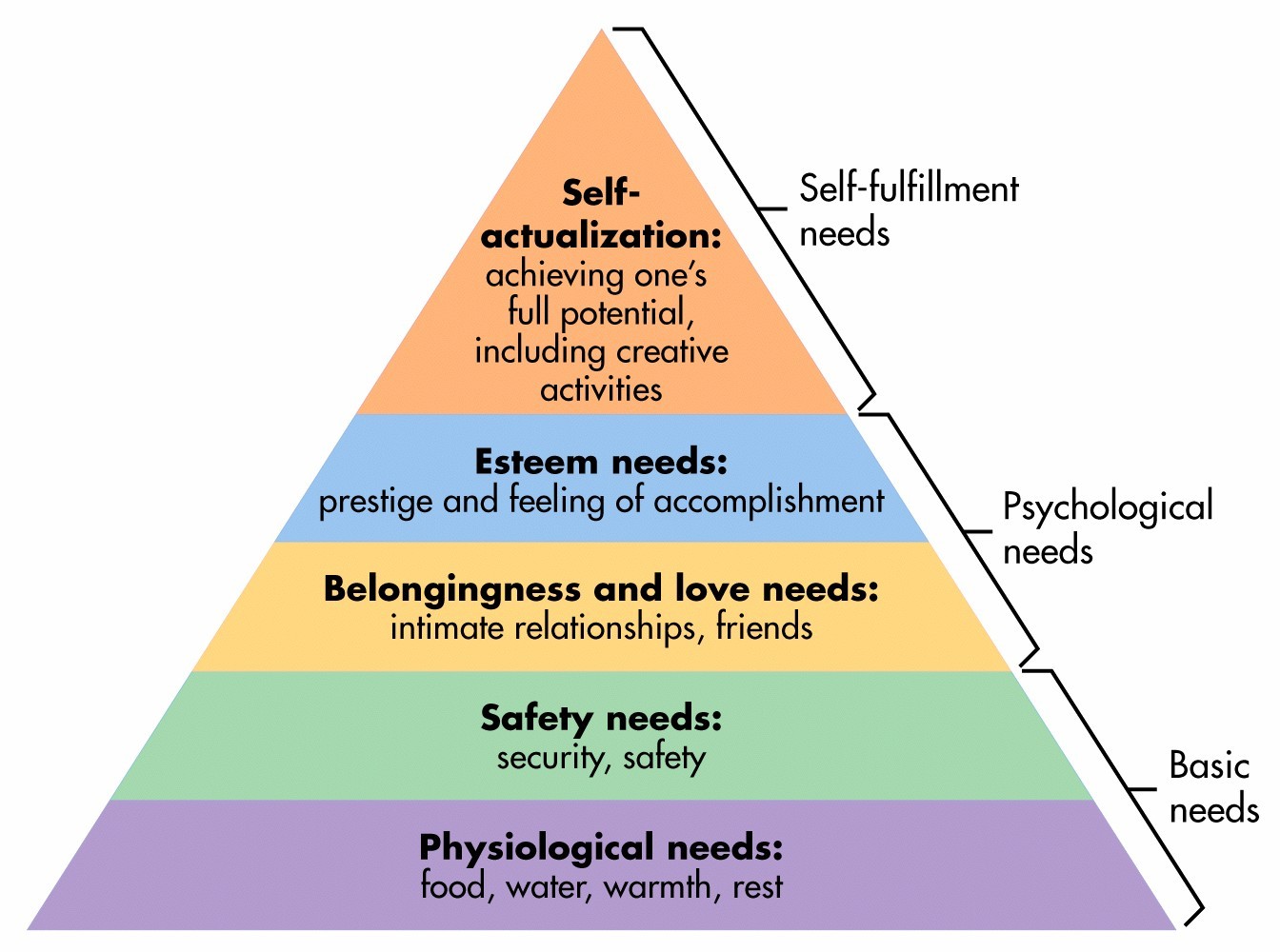
Nowadays in time of increasing sport activities and smartphone apps like Runtastic and Runkeeper where you can track all the information of your run it is time to develop a data logging system for a surf/ snowboard. The surfers can compare their performance or just show them how fast they were. A big advantage is, that there is no product like our already on the market. In addition our surf sensor is indispensable for a surf school because they could teach their customers on a very analyzing and objective way to improve their surfing skills. Another advantage of our product is that we can react spontaneous to several sports/ customer needs by adding sensors. Nowadays this is an aspect which is getting more and more important because of ephemerality. In conclusion our aim is to analyze and satisfy our customer needs so good that our sensor box will sell it on its own. Regarding to the hierarchy of needs of Maslow our products satisfy self-fulfillment needs, which you can find on the top.
Figure 4 - Maslow's hierarchy of needs [28]
In the following marketing report we will write down what our competitors are, what our market is, who our customers are, and our SWOT-analysis.
3.2 Market Analysis
To get to know the environment where our product/company appears we have to examine the markets and conduct a comprehensive market analysis. For a successful launch of our product it is necessary to know the external and internal environmental influences to our product. Therefore we do a SWOT-analysis which shows us the strengths and weaknesses and the opportunity and threats of our surf sensor.
3.2.1Market Dimensions
The sports market is a growing market; people spend in 2012 200 billlion dollars on sportswear, according to euromonitor the market will grow in 2017 to 300 billion dollars. In addition the surf market will grow to 13.4 billion dollar until 2017. Europe represents 32% and has the most growing potential. The sport of surfing has also become a trend and manifested itself into a lucrative market. Therefore we can participate with our surf sensor of this increasing market. Another evidence for a growing market is as already mentioned in the introduction an increasing number of sport logging apps, which record for example the running performance like Runtastic. [29] This is already downloaded for more than 10 Million times and satisfy nearly the same needs as our products. To adopt the concept of Runtastic to the surf sport would be an innovation. [30] [31] [32] We are focusing on the most important surf markets in Europe that are Portugal, Spain and France. One reason is that we can reach our customer easier because of lower market barriers. Another reason is the fact like already mentioned above that Europe has the most growing potential. [33] A third reason is, that at the start of running our company we have the problem that we have had already a lot of costs and we don`t made any money yet. The costs for employes and travelling to non-european countries would be too expensive. We will later have an online store so it is easier to enter other markets worldwide.
3.2.2 Macro environment Impacts
If you launch a new product you have to consider the macro environmental impacts. In the following chapter we will write down the following macro environmental impacts; Political, cultural/social, natural, technological and economical.
Political
If we sell our product in Portugal there are no special taxes and no barriers to progress caused by political restrictions. Because of the EU it is easy for our company to sell our product to Spain or France. In conclusion there are not any impacts which can harm the success of our product.
Cultural/social
It is a general trend worldwide that people get a conscience to live healthy and do sports. In addition the people who do surfing are getting older and the number of woman who do surf sports is increasing. This fact regarding to the demographic change means a good perspective for our product because the people who surf are getting older and the amount of older people is rising too.
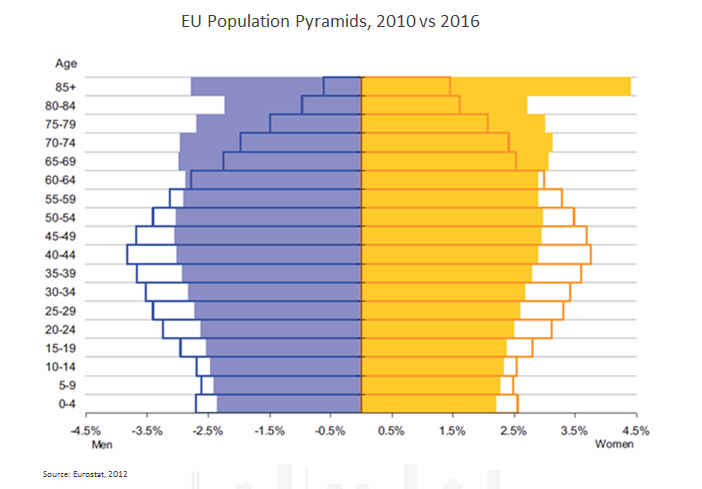
Figure 5 - EU population pyramids 2010 vs 2016 [35]
Because of the fact that needs are infinite and people don`t just do sport but rather visualize and record their performance our product can satisfy this need in the surf sport, because there is no competitor who already does. As already mentioned before, it is common in the running sport to record performances. We have the chance to develop a new market within the surf market.
Natural
The nature has a high impact considering the success of our product. Because of the climate change nobody knows for the long term if our selected countries are in the future still as attractive as they are today. For example if the weather changes in one of our markets so bad that there are no surf able waves, nobody will go there and nobody needs our surf sensor. Technological Nowadays technologies are changing faster than ever before. In addition the acceleration of new technologies is getting faster and faster. Therefore we have to be very flexible and spend continuously time in improving and developing our product. Furthermore we have to do conduct market research in the future to watch out for potential competitors to stay in best market position. Marketing is not a onetime task; we have to do it continuous.
Economical
The economy has a strong impact considering our product. The best proof is the European crisis, which is still ubiquitous. In 2008/2009 the surf industry was in trouble and they had to sell their product for lower prices. However that wasn`t a crisis in the surf industry but every economy sector was affected. So it is just a risk you are not able to reduce. Like already mentioned before the surf market is increasing and a lot of money is earned in this sector.
3.2.2 Micro environmental Impacts
The micro environment influences the business directly. For instance the company itself, suppliers, customer, public and competitors. For a successful business it is fundamental to know them and manage them. In the following we are going to describe those impacts and write down the way we will manage them.
3.2.2.1 Company itself
We are a young innovative company of 5 students. Every one of us has a different nationality and course of study. That is a big advantage regarding solving problems and the way we look at things. To run our company we don´t need much more employees because our core competence is the product development, the marketing and our sales department. The production which requires a lot of money, workers, space and energy will be outsourced to focus on our main competences. These fact keeps the fix costs of our company low and brings us more flexibility to react spontaneous on market changes. Related to our company we have the following advantages/ strengths;
- We are a young dynamic team
- Multinational team member with different cultural backgrounds
- Members of different specializations/ faculties
3.2.2.2 Suppliers
Suppliers have a huge impact on the company’s success. They have to send components reliable, cheap, in a constant quality. In case if one supplier go in administration, we have a big problem. Therefor we have to choose our supplier carefully and draw up contracts which include all necessary conditions. Concerning our project we have to make sure, that there is not just one supplier. If that would be the case, we are dependent to that supplier. Because of using components which are distributed by several suppliers, it is no problem to choose more than one supplier. That makes sure that our production will keep running. Another advantage of our company is that our buying market has a low supplier might because of the easy way to change the delivering company. Our supplier will be Arduino, Mikroelectronica, Microchip and Analog devices. We will use E-Procurement because costs are lower, saving time (process optimization and automation), increase quality and raise flexibility.
3.2.2.3 Customer
The customers are our most important stakeholders. They are existential to keep our business running. No customer no company. It is one of the most important things to know the customer needs and satisfy them properly. Satisfied customers are very import for the marketing because it is one of the best advertisement if a customer convince for instance a friend of him to buy the same product. Therefor our aim is, to fulfill the customer needs on the highest level. Regarding to that companies have to avoid angry customers, those customer could harm a company very strong. Nowadays regarding for instance social networks it is more and more important to avoid negative feedback. That is a reason why we are implementing a customer relationship management system.
There are three different customer markets we are going to enter;
First we are going for the European consumer market to reach high quantity of sales. In addition we are selling our sensor box to surf schools. Because of the multiplication effect, that the surf school is using our product and might convince the students, we can make special prices for them. Another important thing is that we have the advantage, that the changing barriers for the customers are really high, because there are not any competitors right now. On the other hand we have the risk that our product will run as expected because it is a new market. Finally we enter the international market. To reach this market as cheap and easy as possible we are going to develop an online store.
3.2.2.4 Public
The public is also an important stakeholder. The image of the company influences the worth of the brand immediately. It is common to distinguish the public in several groups with different interest:
1. Financial groups: to run our project we need money, we get it from a lender or investor, their interest is to earn money and we have to pay interest and we have to repay the credit. So it might be a financial risk if we don’t earn money early. Another alternative is to go for venture capital, because of the fact that we are a young innovative startup company.
We have now a budget of 600 € from the ISEP. The fact that we are an innovative company with compared to other companies low experience we are going to finance our business after this project by venture capital. There are more than 360 venture capital companies [36]. The big advantage is that on the one hand they can finance our business and in addition they can consult our company.
2.Media groups: media groups have an import influence to our project. For example in case of a bad feedback on social media platforms like already mentioned we have to be aware that small mistakes within our company or product can harm the image of our brand and might lead to decreasing sales. For example, there is one customer who cut his feet because we have designed our Box with sharp edges and ridges. If he post that on our Facebook website we will have a problem.
On the other hand we can increase our brand value if we deal with media groups in a proper way.
To manage all these public issues we are going to launch a public relationship management system and have an employer. His task will be avoiding bad feedback in medias and increase our brand value. More about that is written in the marketing mix.
3.2.2.5 Competitors
We are now alone in the market but there are companies like already mentioned, who will enter the market, so we have to make a closer look on our potential competitors and the benefits of their products. A strong competitor is able to absorb our customer. Therefor we have to improve our products all the time. In addition we have to secure a strategic advantage over competitors by positioning our offerings to be successful in the marketplace.
There are a number of competitors in the data logging industry. We have studied different kind of sensor boxes that compiles with our own.
3.2.2.5.1 Android Sensor Box
Android box is a tool that you can implement in your Android device. It uses many different sensors that can be used in your daily life with a click off a button. The device only detects changes. It may not show the correct temperature, proximity, light and pressure values if no changes occur. For better performances, sensors are usually used together.
Weakness: not waterproofed
3.2.2.5.2 Twine sensor box
Twine is a wireless sensor block tightly integrated with a cloud-based service. The durable, rubbery block has Wi-Fi, on-board temperature and orientation sensors, and an expansion connector for other sensors. The additional sensors can for instants detect floods, leaks, opened doors, and signals from your other home systems. Power is supplied by micro USB or two AAA batteries. By using web app makes it simple to set up and monitor your Twines from a browser. The Twine concentrates on to alert you to small problems before they become big problems.
Weakness: too many sensors which are not necessary and too heavy.
3.2.2.5.3 Sensor-packed SurfSens
The research company Tecnalia and Spanish surfboard manufacturer Pukas have teamed up to create a surfboard that packs a gyroscope, accelerometer, GPS compass, pressure sensors and strain gauges to measure the flex of the board. Last year, four students from the University of California, San Diego, installed a computer and series of sensors on a surfboard with the goal of designing the “perfect” board. Being a student effort, the UCSD board wasn't as refined as the board created by Pukas and Tecnalia, which contains all the electronics within the board itself. The idea of the product is for professional riders to improve their styles using the data collected.
Weakness: still a prototype which isn’t ready for production
3.2.2.5.4 Push Snowboarding (Nokia and Burton)
Nokia, a company incorporating wearable sensors into snowboarding, witch communicates with a smartphone through Bluetooth in real-time. With Nokia’s smartphone’s as a platform for capturing and analyzing data, the mobile application uses the phone’s GPS capabilities along with the data collected from four sensors implemented in the snowboard to provide snowboarders with live tracking of their ride including speed, heart rate, airtime, rotation and a measure of how excited a rider was while snowboarding.
Weakness: doesn’t measure the rotation and acceleration
In conclusion, there is no product like our which targets the same markets as we decide to go in. Additionally there is no product, which satisfies the needs of a surfer. That is a big chance for us to achieve a strong market position.
3.3 SWOT Analysis
The essence of the SWOT analysis is to identify the factors that may affect the operation of the facility. This allows you to indicate the best solution, a course of action to achieve the objectives while minimizing risks, reducing weaknesses and use opportunities and strengths. The SWOT analysis for our product is presented in table 2.


3.4 Strategic Objectives
For a long time success of our product we have to define strategic objectives which we are going to achieve within 5 years.
- Create a long term relationship to our customers by creating a brand value. (brand value( profit))= customer part
- 80% market share in the new market “surfing-logging-system”
- Cumulative turnover of 15 Million Euro
- Enter the US market and after that the Australian market
3.5 Market Segmentation and Targeting
Market segmentation is about the division of a heterogeneous total market in homogeneous submarkets by use of defined characteristics of the potential target group. To define the target market it is important to separate the different market into segments.
Because of the fact that we have compared to other products a small new market we decide to go for the niche marketing. We know our target group and their needs, so we can design and provide our product issues perfect to the customers’ needs.
3.5.1 Market Segmentation of the Consumer Market
In addition it is possible to segmentate the consumer market in four main categories;
Behavior, Geography, Demographics, Psychographics
Behavior Segmentation
There are different characteristics how to divide the total market; loyality,degree of consumer acceptance or usage rate
Geographic Segmentation
Criterias to define a market segment by geographics are; climate, population density,regions, language, cultural factors, economy key figures.
Demographic Segmentation
Different characteristics are; age, position in the family life cycle, household income, religion, graduation, job and citizenship.
Psychographic Segmentation
Criterions are; affiliation to social class, lifestyle, personality
Considering the before mentioned criterions we have to decide the most important for our product to define our own segment which will fits to our product and customers.
Therefor we differentiate the market by geographic and psychographic criterions. The psychographic criterion is the lifestyle of the surfers (4). Our market will be the European surf market. Markets insist of customer. Therefore we divided our market into 5 segments with the following characteristics;
Our first market will be Portugal, Spain and France, because these are the countries with the highest numbers of potential customers (3) and because of the EU the market entering barriers are low. Later we are entering the Australian and US-American market.
In addition we have to differentiate surfers in general (consumer market) and surf schools( business market). So we have to develop later on different marketing mixes to achieve the segments.
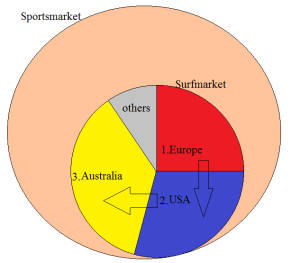
Figure 6 - Market overview
Another market which might be attractive to us is the snowboard market. If our product will run well in the surf market we could analyze the snowboard market and adjust our product design and marketing strategy regarding the results.
3.5.2 Market segmentation of the industrial goods market
To divide the industrial goods market there are the following characteristics common; Sector, criterias of use, organization and execution of procurement, technologies, size of the company, procurement volume The segmentations of the industrial goods market could be useful for us if we decide to sell our for instance to surfboard producer, who integrate our sensor box directly in the surfboard. So it is possible to have two products. One for the consumer who can put the sensor box on his own board and the other one already integrated in the surfboard.
3.6 Strategy/Positioning
The market positioning is a very important part of the marketing strategy. The aim is to convince the customer of our product and increase in public the value and prominence of our brand. That is the reason why we have to choose our market position.
There are four areas where we can differentiate our products; Product differentiation, service differentiation, image differentiation, people differentiation.
We are entering a new market so there a no competitors. Regarding to the companies Pucas and Tecnalia(5) there is a need of the surfers to save the performance. It is very important that our company gets fast well-know, that will bring us market share and the product will sell on its own. We are planning to go on several surf spots and let people check out our sensor and hand out flyers to buy our sensor. Another very important strategic goal is to increase the value of the brand to protect our product/company regarding other new competitors. Therefore our brand has to be associated with attributes like; reliability, high quality, accuracy, cool and innovative. How our company will communicate these attributes is part of the marketing mix.
We decide to develop a website where potential customer can see our product. The distribution will be e-commerce. This has in addition the advantage that we don’t need expensive stores and have a selling pipeline to the whole world. In addition we have a distribution channel to the whole world.
The price for our product will be about 250-300 Euro, if competitors are entering the market there will be potential to reduce the price but first we have to benefit from our monopole position in the market.
To be known as a quality brand our product has to be designed well, work reliable and additionally famous surfers have to use our product. Finally the customer service has to be one the highest level.
3.7 Marketing Mix
3.7.1 Product
Our product is a Surfsensorbox. It records the acceleration and the rotation of the surfboard, saves it and visualizes it on a monitor. The size of the box will be about 15x10x5 cm (LWH). The Box has to be as small and as light as possible so the surfer isn’t influenced by our Box. It is possible to attach the box to every surfboard with cello tape of the brand 3M. If it doesn’t hold, a second cello tape is included in the package.
Since our product is a simple box which is made out of cork, it seems to be very trivial. That is one reason why it is very important for us to attract the customer by the packaging. Furthermore we provide a high quality product so the wrapping should look fancy and signify quality and safety. Therefore we deliver our product in a box made out of cherry wood. Another reason was the sustainability aspect and our corporate identity.
In addition to the box we provide a service. Our service will be a website where you can upload for free your recorded dates and compare it to other surfers. The customer is able to create his own profile with information’s about, age, origin and gender. They have also the option to propose other criteria’s to us so that we develop and improve our platform. After the customer created his own profile and uploaded his dates he is able to compare himself with others. (Another option is that he can highlight on a card the regions he wants to compare) For our company we have a high value because we save dates of surfers. Other companies within the surf market for example clothing brands are interested to post advertisements on our website, to sell their goods. That gives us additional money.
Another value for the customer is that we create a network of surfers, so the customers can contact each other and send messages.
Finally we offer a warranty of 1 year for our product. So if there ary any damages the customer may send us the defect sensorbox and we will fix or replace it.
To see how our sensor box will work: https://www.youtube.com/watch?v=6ijArKE8vKU At the moment we have no prototype but our box will work almost in this way how it is shown in the video.
Brand
Our logo will look like this:
Our slogan is: “ Keep surfing keep logging!”
We decided to keep the design and the logo as simple and expressive as possible.
Our Product looks like this:
This is the packaging: 
3.7.2 Price
We are alone in the market customer haven’t got any comparison, so it is easier for us to get the price we want. We decided to make our price on a cost orientated base, because there is no reference price existing and in addition we can make sure that our costs are covered and are able to define the profit. Our price will cover: material, packaging, labor, interest costs and includes our profit.
Material costs:
| COMPONENTS | PRICE |
| Control panel | 20,00 € |
| Shieldmodule | 19,90 € |
| Bluetooth module | 27,95 € |
| Sensors | 78,95 € |
| Battery/ | 13,95 € |
| Shield module for battery | 17,95 € |
| Micro SD card | 9,95 € |
| Cumulative material costs | 189,00 € |
Those are just the material costs for the prototype. We sould consider that there are additional costs of insurance, fee for salesman and discounts. These mentioned cost are not defined yet and will be added if they are concrete.
The fact that we have just one version of our product we can reduce unit costs, when we start with the serial production. If we make contracts with our suppliers (Arduino, Mikroelectronica, Microchip and Analog devices), we can get it for a lower price. We will also use E-procurement to reduce costs. Then our unit costs of our sensor box will get lower as we produce more.
Our target price will be 250 €. So we have 61 € for packaging, labor costs and profit. That is not much but it is based on the costs for the prototype. When we start serial production our aim is to reduce the highest portion of costs (material) to about 100 €. This is realistic because we ordered our parts for the prototype at www.inmotion.com. Later we will order directly from the supplier. The price for a second cello tape will be 9,95 €. Our service on the website will be for free. Available payment possibilities are: PayPal, credit card and remittance
The final point of our price strategy will be the discount policy. We will offer bulk discounts from an amount of 10 ordered sensor boxes of 20% to increase the number of sales.
3.7.3 Communication/ Promotion
To communicate our brand and product most effective and successful we have several instruments.
On the one hand we will advertise on www.youtube.com. That has the big advantage that we can achieve people who are searching for surf-videos. So we already know if they are searching for a video including the words “ surf”, “surfing” ,“surf competition” that they are interested in surfing and consequently potential customer for our product. A link of our website is shown besides the video, so that the user is immediately able to order the sensor box.
In addition we create a Facebook-homepage where potential customer can communicate to us and get information about our product. This is very important because we can early get feedback of customers, who already bought our product to improve and develop better versions. As an part of our product value management we are going to integrate the customer in our development process to fulfill their needs as good as possible.
Furthermore we will make videos of professional surfers, who are using our sensor box. This will increase the motivation to buy our product.
In addition we will publish advertisements in several surf magazines like www.surfingmagazine.com , www.surfermag.com to get in the peoples mind as fast as possible and to increase our popularity.
Moreover we will show posters in surf schools. We are going to convince and involve the surf instructors to promote our product.
Additionally promoters are visiting several surf competitions in Europe and hand out our leaflet. There are surfers in the competition who have our sensor box attached. On a big screen at the beach the audience is able to see the measured dates, like who did the most rotations or who had the fastest acceleration. That is totally new in surfing sports and will be a highlight on every competition.
Finally promoters are visiting several surf competitions in Europe and hand out our leaflet. There are surfers in the competition who have our sensor box attached. On a big screen at the beach the audience is able to see the measured dates, like who did the most rotations or who had the fastest acceleration. That is totally new in surfing sports and will be a highlight on every competition.
3.7.4 Place
At the beginning we are going to offer two distribution channels. The first will be the internet. We sell our product on our website, because there are two big advantages. On the one hand it is compared to a store cheaper because we don´t need buildings and seller. Another reason why a store doesn’t make sense is the fact, that we just sell one product. Using our website as a distribution channel we can sell our product worldwide. Furthermore we are able to enter new markets easily.
For the first year we will have a second distribution channel. Our company will employ several salesmen, who are visiting the most popular surf schools in Europe to introduce and sell our sensor box. Surf schools can demand more money from the surf students, because they are using our sensor box, which is an innovation and separates them from competing surf schools. Moreover surf instructors will get 10% of the selling price if they convince a potential customer to buy our product. So it is a win-win situation. The surf instructor earns money; we earn money and increase our market share without having high cost for employing seller.
For the future we have to evaluate the effectiveness of the salesmen and decide if it is necessary to employ them to keep the customer relationship good or if it is enough if we stay in contact to our customers via our website or Facebook page. If we reduce the amount of employed salesman we also reduce our fix costs.
3.8 Budget

Action Plan

3.9 Strategy Control
Our company has to observe both micro and macro environment all the time to ensure that we can meet customer needs and demands. We need to study any competitors and advertise and show that our product is the one to have. Companies that ignore changes on the market will most certainly be left behind. We have to stay updated on political and economic changes in the market environment. We have to follow the social trends to ensure that we do not get left behind. The controlling process must be continuous in order to stay attractive to the customers on the market. This process is illustrated in FigureX.

3.10 Conclusion
Our company consists of young innovative people with 5 different nationalities. With our Surflogger we are going to create a new market in the surf industry, where at the moment we made the market research no other company is present. We are going to awake new needs of the surfers and start penetrating this new market. Therefore is our aim to sell within 5 years 60.000 units which accords 15 Million Euro and have a market share of 80%. To increase our popularity and value of our brand we will work together with surf schools and will go to several surf competitions. Additionally we will launch an online store, a Facebook page and sponsor famous surfer.
4 Eco-eficiency Measures for Sustainability
4.1 Introduction
The EPA’s definition of sustainability is based on a simple principle. Everything that we need for our survival and well-being depends, either directly or indirectly, on our natural environment. Sustainability creates and maintains the conditions under which humans nature can exist in productive harmony, that permit fulfilling the social, economic and other requirements of present and nature generation .’ [39] Due to this define, all request will be found in our natural environment and may be used limitless but the important point is ‘using without waste’. Authorities that are in this field are trying to find more sustainable devices. To specify the way of execute and make it easily understandable, they divided the sustainability into these six important points:
- Energy conservation
- Energy Efficiency
- Demand science management
- Renewable
- Diversification
- Externalities Internalization
According to these six points, we can see and apply sustainability to every part of our life. In this project, we mostly focus on energy conservation and to create a prototype that has low energy consumption.
4.2 Environmental
Green Factory
When we start to build our factories, we planned to design them as ‘Green Factories’. What is the green factory? Based on that, we have made some research. After the research, we have found ‘LSIS FACTORY’. They are achieving the company vision that incorporates low-carbon energy resources, environment-friendly devices and energy management system to minimize greenhouse gas emission, waste of energy and environmental pollution [40]. So, designing it as green factory, at the beginning can be non-profitable but over the long term, it is profitable. Our next aim is to certify our factory to Leadership in Energy and Environment Design (LEED) that is a green building certification program that recognizes best-in-class building strategies and practices. [41] We can receive gold certification from LEED. We decided to go a step further. We planned to integrate our green factory with ‘ISO 14001:2004’ certification. This certification sets out the criteria for an environmental management system. It does not state requirements for environmental performance, but maps out a framework that a company or organization can fallow to set up an effective environmental management system. It can be used by any organization regardless of its activity or sector. Using ISO 14001:2004 provide assurance to company management and employees as well as external stakeholders that environmental impact is being measured and improved.[42]
The benefits of using ISO 14001:2004 can include:
- Reduce cost of waste management
- Saving in consumption of energy and materials
- Power distribution cost
- Improved corporate image among regulators
- Customers and the public[42]
Saving Energy
Nowadays, the important problem that every business has to tackle is energy efficiency. Energy efficiency is important because, it saves money; it is good for protecting the environment and improves national security [43], [44]. According to these reasons, we realized how important energy efficiency is and why it is significant to find a way to save energy. Our company is going to buy our components from suppliers. This means that in the producing stage we don’t consume much energy compared to if we would make the components our self. But on assembly work, we have to use much energy. After long research, we decided to play along with WWF (World Wildlife Fund). WWF is an international non-governmental foundation that research ways to protect nature and put them into practice. In the future, we aim to take Gold Standard Renewable Energy Certificates that is supported by WWF. This certificate is the most rigorous certification standard globally for carbon offset project. It ensures that energy efficiency and renewable energy project actually reduces carbon dioxide (CO2) and provide benefits for the local population. [45], [46] Additionally, to conserve energy, we are planning to install efficient electrical fittings. A building management service with occupancy sensors will monitor and manage heating, ventilation and air conditioning and innovative vapor absorption machine will capture heat from generators to enhance cooling capacity, glass roofing will keep artificial lighting to a minimum. Combined with solar power this will reduce nonmanufacturing energy by 30%. [47]
Reducing Ecological Footprint
Ecological footprint is a measure of human impact on the Earth’s ecosystem. Devices, materials, items, have environmental impacts so, they have an ecological footprint. The most important thing that we have to do is reduce and, if it is possible, minimizes it. Based on this idea, we tried to find a way for reducing impacts and found two ways. They are:
- recycling materials for the product cover
- recycling battery
We ask ourselves the question ‘How can we make our surf logger more sustainable and minimize the ecological footprint?’ and to do this with focus on energy conservation. We decided to use a rechargeable battery. In comparison to have a dischargeable battery, we can charge and recharge it many times. Therefore, we do not have to change the battery as often. On the other hand, all parts of our device we tried to do use recycled materials but it was not easy because they are electronic. However, when we considered cover material we decided to use ‘CORK’.
Figure 11 - Prototype of case
Cork is a flexible, impermeable, buoyant and compressible material. As much as fire resistant, it is also a thermal insulator. Cork suits very well as a cover material for our product because t’s lightweight and waterproof. The Cork industry is considered an environmental friendly industry. The sustainability of production and the easy recycling of the cork products are two other important properties that affected our decision. As a consequence, ecological footprint is reduced thanks to cork. [48], [49]
4.3 Economical
Economic Concern for Cork
We do not have to spend much money for transportation of our raw materials because; Portugal is a major cork-grower. Nearly one-third of the total cork oak area, estimated at 2.150.000 hectares (5.3 million acres) is in Portugal. [50]
Economic Concern for Delivery
On the other hand, both professional and regular surfers will use our surf logging device. We will sell it especially and firstly in Portugal and then expand to France and Spain. Transportation costs will not be so high because we will have production in Portugal. The transportation to other countries and continents will be provided by ship in the harbour of Porto.
Economic Concern for Battery
Additionally, we have used a lithium battery. Lithium batteries are primary batteries that have lithium metal or lithium compounds as an anode. The major differences from other batteries are their long life capacity. The most known types are lithium-ion batteries and lithium-ion polymer batteries. Because of the lightweight, we use lithium-ion polymer batteries. Evaluate long life- high cost, maybe beginning it cost much, they are quite expensive, but over the long term it is profitable. [51]
Producing Surf Board with Surf Logger
Our intention is to for the future have a partnership with some surfboard manufactures and by this implementing the surf logging system directly into the surfboard. Thanks to that, we can reduce manufacturing cost. Further, clients do not have to buy them separately; buying a surfboard also gives you the logger.
4.4 Social
Factory Fires
Following the factory fires that have happened all around the world; we felt it is important to review the building safety. The issue of sustainability was addressed from the perspective of ‘sustainable construction’ and its adaptability to fire safety. The issue of environmental certification in Portugal leads by environmental ‘LiderA’: voluntary system of evaluation of sustainable construction and environment was also addressed. We are planning to apply to their evolution and take the certification for our factory. [52]
Fair Wage
What is a fair wage? How much should it be and how should it be paid? The Adidas Group has asked themselves these questions. Following the answers they have made an interview with their employees and suppliers. They have conducted a series of Fair Wage assessment. Result of the assessments like this ‘Many of the assessment findings were encouraging. Suppliers paid wages on time, complied with legal minimum wage rates, and the wage structure consisted of many non-monetary benefits. Different forms of communication to workers about their pay were noted, and there were no practices that allowed wage discrimination or wage disparity. Wage costs continued to rise as employers tried to meet increased cost of living’. [53] Following that, on our company we aim to do these assessments so, we can associate strongly with our suppliers and employees.
Concerning Worker Health and Safety
Factories have potential risks to workers health and safety. It depends on size and type of the factory. But we can manage these risks by supporting the adopting policies, conducting training and following best practices to protect workers. We aimed to reduce risks by using less hazardous materials in the producing stage. By creating a healthy management department, we support our employees to reach a healthy life-style. They can access to medical services such as vaccinations, medical checks and ergonomic workplace adjustments. [53]
Fair Working Environment
People are exposed to discrimination on many different ways; sexual orientation, gender, age, skin color or looks. We respect and offer fair working environment to our employees. Consequently, each employee can feel fulfilling with self- confidence and welcome to be part of our company. [53]
Tackle to Costumer Expectation
Costumers always expect a company to supply them with top- quality products and services. They are satisfied if their expectations are met. If the customer receives efficient and helpful service and feels that company really cares about them, this will result in a happy customer who is more likely to buy the company’s products again. We have planned to give good services to our customers too. To evolve out of this idea, we have combined all sensors in a box. If there will be a problem, they can change just broken parts instead of throw them to garbage. It means that they save money.
4.4 Life Cycle Analysis
The International Organization for Standardization (ISO) defines Life Cycle Assessment as ‘Compilation and evaluation of the inputs, outputs and the potential environmental impacts of a product system throughout its life cycle‘.[54] If we define it obviously, Life cycle analysis (LCA) is a tool that can help to understand the environmental impacts associated with products, processes, and activities.

Figure 12- Life cycle analysis for products
The points that are mentioned below are taken into account when life cycle analysis evaluates:
- Raw materials production
- Manufacturing
- Product use
- End of life
And a sustainable design should contain all these points. We tried to design our product according to them.
Raw Materials Production
First of all, we have to focus on raw materials. We do not have real raw materials, everything is already produced. Our surf logger consists completely out of electronic parts. We have bought them from a supplier. For reducing cost we have elaborated to buy materials from Portuguese suppliers. Thereby, the transportation costs were reduced. Also, we have researched and focused our case material ‘cork’ that is playing important role in Portuguese market. It has been estimated that the foreign income for cork in Portugal is about 16% [49]. Therefore, the case will be designed out of cork.
Manufacturing
On manufacturing stage, solar panels that are used in factory help us to provide the factory with electricity. According to Toyota Factory (in Tsutsumi/JAPAN), half of the electricity comes from the solar panels. 50.000 m2 of solar panels reduce CO2 emissions by 740 ton a year. In the same factory (Toyota Factory in Tsutsumi), water recycling program has led to % 50 reductions and factory water discharged to the local river system. Also the discharge water is 5 times cleaner than the river water. Additionally, photocatalytic paint cleans the air by producing O2 and sunlight. 2000 m2 area that painted with photocatalytic paint has the same effect with 2000 trees produce O2 and sunlight. Following that, in our factory, CO2 emission and electricity expenses are reduced by solar panels, we can clean the water and air with comprehensive water recycling system and photocatalytic paint. [55]
Product Use
We try to produce a surfboarding logger and thanks to this device we aim to measure rotation and acceleration, things that can be interesting to know for the surfer.’ Our belief is that thanks to the information surf will become getting more attractive sport.
At the beginning, we have had two options. One of them is about using two processers. It means more energy consumption than one processer. Also it would have been more expensive and harder to program. So, we have chosen to use one processer. For power consumption, we have used ‘lithium-ion polymer rechargeable battery’. Lithium-ion battery has very high energy density and very low rate of self-discharge. [56] It has made our decision very clear. Further, it does not contain toxic metals so there is no risk of harm.
End of Life
On last stage of life cycle assessment, end of life, we have focused on two main points. They are maintenance services and recycling. Primarily, our device should be repaired, when it is broken. With a good maintenance service, we can manage it. Sometimes the service can be a problem, because of the fact that repairing can be much more expensive than buying a new one. After setting up a recycling storage, customers can be promoted about giving old devices back. It is the best way for recycling electronic devices.
4.4 Conclusion
Eco-efficiency and sustainability have important role for every business. As much as saving world, it is profitable. That is why factories make sustainability reports. We tried to make reports for every parts of surf logger production. It is sometimes challenge because we are trying to improve a prototype. Thing that we have to do for now, create a prototype after we can concern about sustainability part. But we have counted some ideas on every field and tried to the best.
5. Ethical and Deontological Concerns
5.1 Introduction
P. Drucker once said that: “Ethics and morality is not everything, but without it, nothing can fail you.” It is well to remember that gold mind and realize how important aspect is an ethics in all areas of life, including the creation of a new quality. It is the foundation of all activities and it indicates the direction of the conduct.
When a new device is created, there are many ethical issues at different levels and stages of the product development that should be considered.
The subject of ethical considerations in this section will be product design, its functionality and built in accordance with the law of intellectual property protection, launching the product on the market and setting a marketing strategy, but also the impact on human health and the environment.
For each of these areas we meet with situations that are not black and white, but complicated, focusing much of tangled relationships. Conflicts of interest and inequalities of different sites make it difficult to take the appropriate, ethical decisions.
We should remember that all behaviors and decisions, which are taken by the company, shape its image and market position. Ethical activity builds trust and relationships with business partners, suppliers and customers and as a result it ensures stable development, therefore it should be the basis for the functioning.
5.2 Engineering Ethics
The technique has a significant impact on the quality of life for all people. Engineering activities as a service to the public is the carrier of its civilization development and it co-creates its culture. That is why the attitude and conduct of engineers who have the direct link to it is such important. Therefore, before we proceed to discuss ethical issues in relation to the project and different stages of development of the device, we should look at the responsibilities and requirements regarding the attitude presented by engineers. Standards of good practice in the technique are formulated in The Engineering Code of Ethics. These are general and addressed to all engineers. They should be interpreted in relation to the specific activities and his team.
Fundamental Canons
1. “Engineers shall hold paramount the safety, health and welfare of the public and shall strive to comply with the principles of sustainable development in the performance of their professional duties [57].”
One of our main goals is to create a product that will not pose a threat. Its construction will enable safe use. The project also aims to create a device that as far as possible is the most environmentally friendly. An example is the use of the case made from organic material or minimization of energy use. The device will be useful for sporting environment and designed in order to provide benefit and meet the needs of this community.
2. “Engineers shall perform services only in areas of their competence [57].”
Because the members of our team do not have knowledge of all fields of science that are related to our project and do not have experience in the implementation of projects, each issues and decisions are discussed with relevant persons. A course of the project is supervised.
3. “Engineers shall issue public statements only in an objective and truthful manner [57]”.
It is the rule, which we have especially in mind in the planning stage marketing strategy. The product will be presented in a fair manner, consistent with the actual state. Information about the operation of the device like battery life will be accurate and truthful, so that future customers can form themselves an objective opinion about the value of our product.
4. “Engineers shall act in professional matters for each employer or client as faithful agents or trustees, and shall avoid conflicts of interest [57].”
As the designers and manufacturers we strive to create and launch the product on the market, which the advantage is the uniqueness. In order to achieve this, everyone should keep information regarding the designed product and development plans in secret, because they determine the success of the company. In addition, our team is not going to create devices for market competitors by making for them the products, which will compete in the market.
5. “Engineers shall build their professional reputation on the merit of their services and shall not compete unfairly with others [57].”
Due to the fact that each member of the group specializes in a different field we made a fair division of labor. Co-authorship of the project includes all members of the project team. Moreover, whenever we use in our project the knowledge or information other people we do not recognize this part as our own, but every time we put the appropriate endorsements in the report.
6. “Engineers shall act in such a manner as to uphold and enhance the honour, integrity, and dignity of the engineering profession and shall act with zero-tolerance for bribery, fraud, and corruption [57].”
Our report includes a list of materials and components needed for the project. We published information about how we allocated the funds, which we received and about sources of acquisition of needed materials. Any funds received for the project implementation has not been used for personal use.
7. “Engineers shall continue their professional development throughout their careers, and shall provide opportunities for the professional development of those engineers under their supervision [57].”
Each of our team members strive to expand their knowledge in their field in order to perform assigned tasks properly and thoroughly and to be able to fully engage and contributions in its implementation. In addition, each of our team appreciates and respects the work and contribution of other people, and supports helps and motivates.
5.3 Sales and Marketing Ethics
Ethical problems arise especially in marketing activities. Nowadays, many companies do not follow the ethical standards in their actions, because the attitude of a quick profit causes that they are subject to many temptations. We are aware that violations of ethical principles such as withholding information, the administration of technical specifications, which are inconsistent with actual state, bring only temporary financial benefits, but in the long term, it causes a deterioration of the image of the company, loss of credibility and above all, the loss of customer’s confidence.
We want to make communication with customers transparent, understandable, and appealing to facts about the products. Only relationships based on honesty, trust and striving for mutual benefit will enable the success of the product on the market. We want to provide a product for future customers with good quality at an appropriate price to its value. Our intention is, that the advertisement informs buyers about all the possible benefits which can be gained as a result of its use, but also about the most important technical details of the device, so that the customer will be able to determine their compliance with their requirements and make an informed choice, consistent with their expectations.
Surf Logger is designed to be used, inter alia, in the competition. That is why it is such important that device has to provide the exact measurements and perform functions in line with the declarations. To guarantee it, the device will enter the appropriate tests, which will prove its quality. Thanks to this we will be sure that our customers will receive efficient device in accordance with the promises. Our intention is not to create false advertising, which promises potential users something that cannot be delivered. We also want to move our advertising people to choose and act rationally in morally good ways.
5.4 Academic Ethics
During the implementation of our project and create a report we often derive knowledge and information from other sources. However, when we do it, we use quotation marks and we give proper acknowledgment of sources in Bibliography. Also, when we include pictures, or the results, we give proper citation.
An ethical concern regarding to academic issues can also be connected with our group. A relationship in our team is based on respect, kindness, solidarity, loyalty and cooperation. This provides a good atmosphere in our team, increases motivation and enthusiasm for work, but also affects its efficiency.
5.5 Environmental Ethics
With regard to the environmental ethics, the key word is recycling. Nowadays there are service points that offer collection of dead batteries and later send them to collection storages for recycling. For example, Li-ion batteries are processed to recover cobalt, iron and other metals.
We know that there are companies dealing with this problem, but it’s hard to determine how efficient the recycling for the following technical reasons:
- Composition of the feed material entering the process varies considerably and consistently between batches and also between countries due to the market mix of batteries sold and discharge state of batteries collected.
- Many processes integrate battery recycling with other waste feed streams, the determination of recycling efficiency of individual components from batteries versus those from other input streams is therefore very indistinguishable.
- Output of certain recycling processes are further processed at other facilities, the boundaries across which the recycling efficiency is to be measured are blurred. [58]
We can discuss the efficiency and other factor of the recycling process but we must remember that we are obliged to follow the European Union battery recycling law.
5.6 Liability
Legal Liability
Our Surf logger is meeting with following directives:
- Electrical Safety: Low Level Voltage Directive
- Restriction of Hazardous Substances (ROHS) in Electrical and Electronic Equipment Directive
- Mandatory implementation and use of the International System of Units
Criminal Liability
We must do our best to avoid negligence and accidents that could expose consumers to risk. Our product will be tested so it is not dangerous or harmful to humans in any way.
Professional Liability
We ought to follow the engineering code of ethics. No steps to complete the project should be sidestepped and we must meet the terms of the obligations and produce our prototype in the exact way as it was originally planned.
5.7 Intellectual property
The technology is open source and therefore not patented but we have developed and design a unique product. We cannot patent our product but we can patent our brand and the design of the finished surf logger box. We would like to patent our brand in the big surf markets, which are Australia, USA, Portugal, and Southeast Asia.
5.8 Conclusion
The different ethical considerations regarding our project are presented above. It still needs continues work and should always be researched and improved so we are compatible with the engineering code of ethics and use the latest and best solutions for the ethical concurrences. The next chapter will discuss project development regarding our components and functionality of the prototype.
6 Project Development
6.1 Introduction
In the following chapter we are going to explain how our project has grown: how we have bring it to the current state. We will write about ours solutions regarding to the architecture, software development and components. The main headlines are divided as follow we are going to present first our components, talking about what does each one do; in architecture and software development we are going to talk about signal and electrical architecture and how put everything together. We are going to talk about the software solution chosen, and then in the functionalities we are going to explain the features of our project and what the code do. Finally at the functional tests we will describe some experiments in order to try out the functionalities. Conclusion presents our achievements and how it can be improved in the future.
6.2 Architecture
Electrical architecture
The power supply in our project comes from Li-Poly 2000 mAh battery. This battery has a nominal voltage of 3.7 V. We will convert this voltage with the battery charger and boost it uptil 5 V. The output of the booster is directly connected to the arduino 5 V. voltage input then the Arduino linear regulator and the wireless shield linear regulator take care of providing the sensor stick and the Bluetooth radio the right amount of voltage (3.3 V). The TMP 36 temperature sensor is fed at 5 V. by the arduino output in the following sketch we have the electrical architecture as well as the power consumption in mA.

Figure 15 - Electrical architecture of surf logger
Signal architecture
The 9 Degrees of freedom-sensor stick is communicating with an I²C (Inter-Integrated Circuit) interface with the Arduino Uno. I²C is a multi-master serial single-ended computer bus invented by the Philips semiconductor division. I²C uses only two bidirectional open-drain lines, Serial Data Line (SDA) and Serial Clock Line (SCL), pulled up with resistors as we can see in the following sketch it’s not necessary for us to add the pull up resistors because they are included in the mate.

Figure 16 – I²C [68]
The TMP 36 temperature sensor it’s connected to an arduino analog input this analog signal follow the graph shown below.

Figure 17 – Output voltage vs temperature [69]
These signals are processed on the Arduino CPU and sent by the arduino serial port that is used the Bluetooth interface to send the data to the PC where the processed signals are used to visualize a 3D model of the board. Additionally, this data are also sent to the SD card in order to have a backup copy of the session if Bluetooth communication is lost.

Figure 18 - Signal Architecture
Physical connections
In the following fritzing diagram and in the table below we will explain the physical connections between all the components. The Bluetooth radio It is represented with XBee radio because they have the same footprint and the SD card is not represented in the in the diagram but it’s just plug on the SD slot of the arduino wireless SD shield.

Figure 19 - Physical schematics
The connections between wireless shield and the Arduino uno and the connection between wireless shield and the Bluetooth radio are easy. Each one is mounted to the other, staked because the footprint of one matches perfectly with the pins of the other as we can see in the Figure 19.

Figure 20 - Arduino Uno + Arduino wireless SD shield [70]
In the Figure 21 we can see and XBee module plug into the wireless shield but as we have explain we will use a Bluetooth antenna that can be plug in because it has the same footprint (show Figure 21)

Figure 21 - RN41-XV Bluetooth Module [71]
Cork Box Design


Figure 22 – Surf Logger box
The box made of cork and with two straps that keep the box together. There is rubber tightening in between the two halves and this makes the box waterproof.
Software development
For the software development we drew upon the free firmware to provide with the 9 DOF sensor stick in order to build our code. This firmware under GPL license allows us to read the information of the sensor stick put them in an I²C interface. It is processed and filter with the mathematical background that we will explain in the next point and sent using the serial port of the Arduino Uno. The firmware also included a processing sketch that can read this data and send through the serial port and draw a real-time 3D model that give us the orientation of the stick. In the documentation and the code, we can also find some information about how to send the data to an Android device and run the processing sketch on it.
We also want to save data in the SD card so we will use the SD library that allows for reading from and writing to SD cards on the Arduino wireless Shield.
Due to the box of cork and the difficulty of calculating the heat generated by the components, we will implement a function that could turn off the device when the temperature can damage the components.
6.3 Components
As you see in the state of the art part of the report, we had three different options to develop our project and finally decided chose the option A that consists Arduino Uno board acting like a CPU and a sensors stick that provides us all the information that we need. That option provides the possibility for adding new sensors like the temperature sensor. The reason to add temperature sensor to material list is that if there is a possible overheating risk that could damage the components, we can predict it before. In Table 14 material list is shown.
We also need some male to male wires and female headers for making the connections.
Arduino Uno
In addition to all the features of the previous board, the Uno uses an ATmega16U2 instead of the 8U2 found on the Uno (or the FTDI found on previous generations). This allows for faster transfer rates and more memory. No drivers needed for Linux or Mac and the ability to have the Uno show up as a keyboard, mouse, joystick, etc. [59].
The Uno R3 also adds SDA and SCL pins next to the AREF. In addition, there are two new pins placed near the RESET pin. One is the IOREF that allow the shields to adapt to the voltage provided from the board. The other is a not connected and is reserved for future purposes. The Uno R3 works with all existing shields but can adapt to new shields, which uses these additional pins [59].
As shown in Table 15, the official specifications are taken from the producer's webpage.
Table 15 – Arduino specifications [60]
| Microcontroller | ATmega328 |
| Operating Voltage | 5 V |
| Input Voltage (recommended) | 7-12 V |
| Input Voltage (limits) | 6-20 V |
| Digital I/O Pins | 14 (of which 6 provide PWM output) |
| Analog Input Pins | 6 |
| DC Current per I/O Pin | 40 mA |
| DC Current for 3.3V Pin | 50 mA |
| Flash Memory | 32 kB (ATmega328) of which 0.5 kB used by bootloader |
| SRAM | 2 kB (ATmega328) |
| EEPROM | 1 kB (ATmega328) |
| Clock Speed | 16 MHz |

Figure 13 - Arduino Uno [60]
The 9DOF Sensor stick or put in another way a sensor board with 9 degrees of freedom. Includes the ADXL345 accelerometer, the HMC5883L magnetometer, and the ITG-3200 MEMS gyro has a I2C interface in the followings we show the specifications of all the sensors.

Figure 14 – Sensorstick [61]
Arduino Wireless SD Shield (XBee Ready)
The Wireless SD Shield allows an Arduino board to communicate using a wireless module. It is based on the Xbee modules from Digi, but can use any module with the same footprint. The module can communicate up to 100 feet indoors or 300 feet outdoors (with line-of-sight). It can be used as a serial/ USB replacement or you can put it into a command mode and configure it for a variety of broadcast and mesh networking options [64].
If we would need to cover a larger distances we could use the XBee Pro model instead. These radios can get up to 1.5 km communication in line of sight. The on-board voltage regulator can supply enough current to power these radios. The shields breaks out each of the Xbee's pins to a through-hole solder pad. This shield is also compatible with other radios using the same socket [26].
Included on the board is a SD card slot accessible through the SD Library. When using the SD Library to access the card.
BTBee Pro Bluetooth Module
The RN41XV is a small form factor, low power Bluetooth radio module offering plug-in compatibility for the widely used 2 x 10 (2 mm) socket typically used for 802.15.4 radio modules. Based on the popular 2 x 10 (2 mm) socket footprint often found in embedded applications, the Roving Networks’ RN41XV module provides Bluetooth connectivity in legacy and existing designs that have been based upon the 802.15.4 standard [65].
The RN41XV is built upon Roving’s RN41 low power Bluetooth module. The module has an embedded Bluetooth stack and supports multiple interface protocols and profiles including the commonly used SPP and HID profiles [65].
Battery
Rechargeable lithium polymer battery that provides our device with the energy we can see the specification and the safety performances in the followings table specifications and safety performance.
The speciation of the output of our battery is 3.7 V, so we need to change this voltage to an accurate one for our arduino board. We can make it by using two batteries in series and using the voltage regulator of the arduino board Input Voltage (recommended) 7-12 V or using a boost regulator to 5 V and connected to the arduino board without using the regulator of the board.
The output voltage of our battery is 3.7 V but 5 V is needed to arduino board. For changing this voltage to accurate to our arduino board, there were two options. First, made it by using two batteries in series and use the voltage regulator to regulate arduino board Input Voltage (recommended) to 7-12 V. Second one, use a boost regulator to reach 5 V and connected to the arduino board without using the regulator of the board. We preferred second option because using two batteries means that the linear voltage converter are reducing the voltage to 5 V with an approximately efficiency of 65% much less than the one boost converter give us.
Battery Charger/Booster
The PowerCell board is a single cell LiPo boost converter (to 3.3 V and 5 V) and micro-USB charger in one. The features are:
Features:
- MCP73831 Single Cell LiPo charger at 500 mA
- TPS61200 Boost Converter
- Selectable output voltage 3.3 or 5 V
- 5V @ 600 mA max
- 3.3V @ 200 mA max
- Undervoltage lock out at 2.6 V (with disable jumper)
- Quiescent current, less than 55 uA
- JST connector for LiPo battery
- micro-USB connector for charge power source
- Inductor: 4.7 uH, 1.2 A Sumida CDRH2D18
- Over temperature protection
Micro SD Memory Card
Kingston 8 GB Class 10 micro SD memory card is used for saving data.
Temperature Sensor
The TMP36 is a low voltage, precision centigrade temperature sensor. It provides a voltage output that is linearly proportional to the Celsius temperature. The features are:
- Voltage Input: 2.7 V to 5.5 VDC
- 10 mV/°C scale factor
- ±2 °C accuracy over temperature
- ±0.5 °C linearity
- Operating Range: −40 °C to +125 °C [67]
Cork Block
To cover the surf logger cork is used because it is a flexible, impermeable, buoyant and compressible material. As much as fire resistant, it is also a thermal insulator. Cork suits very well as a cover material for our product because it’s lightweight and waterproof. The cork industry is considered an environmental friendly industry [48], [49].
6.4 Functionalities
Read and process the data from the sensor stick
As explained in the section of software development, reading and visualization the data collected from the sensors is based on the razor-9dof-ahrs firmware. The first thing to get working is that the software is supposed to read the data from the sensor stick that includes the ADXL345 accelerometer, the HMC5883L magnetometer and the ITG-3200 MEMS gyro. The second thing to work on is to get the data from all sensors. It uses I²C interface (as explained in signal architecture).
In order to read I²C signals, the Software uses the wire library that allows communicating with I2C / TWI devices to the Arduino. For using the wire library it’s necessary to know the addresses of each device that are provide in the datasheets of the devices. With the wire library, the rate is adjusted to 50 Hz (25 Hz bandwidth) because the main loop runs at 50 Hz and the data from the sensors are read with a 6 byte resolution (2 each axis).
Once the code has read the information from the sensors the readings are corrected with the Sensor calibration, scale and offset values. We want to know the exact orientation of the surfboard. This means that we need the yaw, pitch and roll angle.

Figure 23 - Explanation of yaw pitch and roll in a surf board [72]
Accelerometer and gyroscope are hard to use separately to measure the angle position. Angle position is derived from the accelerometer. It has noise, while the gyroscope is showing the drift. Though accelerometer gives noisy output, its measuring error is conservative. On the other side, gyroscope gives relatively noise immune output for short time duration, though its error will be diverged for long time period. With these characteristics, we can see that two sensors are in complementary relationship. If gyro drift can be corrected by accelerometer, the output angle can have reliability. Likewise, improved output can be calculated by the combination of two complementary sensors. The magnetometer gives as a yaw correction by measure the magnetic north.
Internally the fusions of accelerometer, magnetometer and gyroscope data are done to use a Direction Cosine Matrix (DCM) algorithm. The algorithm also takes care of handling sensor noise and numerical errors. It is based on a paper by William Premerlan on the theory and implementation of a direction-cosine-matrix (DCM) [73].

Figure 24 - Block diagram of the DCM [73]
Posture data (Euler angles) of the board are get from the gyro. For the roll, pitch, and yaw, three rotation matrices X, Y, and Z can be calculated:

Then, direction cosine matrix (DCM) is given as:

With this matrix, representing of board’s posture in 3-dimensional space is possible. Each of the rotational drift correction vectors (yaw and roll-pitch) are multiplied by weights and fed to a proportional plus integral (PI) feedback controller to be added to the gyro vector to produce a corrected gyro vector. That is used as the input to equation. Proportional plus integral feedback controller are used to apply the rotation correction to the gyros, because it is stable and because the integral term completely cancels gyro offset, including thermal drift, with zero residual orientation error[73], [74].
Sensor Calibration
The firmware also implements some settings options to improve precision and responsiveness for sensor calibration. If the sensors are not calibrated, they may effect like:
- Drifts in yaw when applying roll to the board.
- Pointing up does not really result in an up attitude
To calibrate the sensor stick we have to know that the definition of the axes differs from info that is printed on the board. The firmware uses:
- X axis pointing forward (towards the short edge with the connector holes)
- Y axis pointing to the right
- Z axis pointing down
This gives a left-handed coordinate system. We can see the three axis draws over the sensor stick in the Figure 25.
Figure 25 - Coordinate System for sensor stick [61]
It’s recommended to power up the Razor a few minutes before calibration, so the sensors can warm up.
As explained in more detail in the following section the yaw pitch and roll angles are sent to the pc by using the serial interface, we will also use this in order to calibrate the sensors. Sending by the serial monitor the string #oc is set the firmware output to calibration mode like shown in the following part of code:
This code receives every four acceleration values and shows on the monitor the maximum and minimum values, so we see something like accel x,y,z (min/max) = -5.00/-1.00 25.00/29.00 225.00/232.00 in our serial monitor.
To calibrate accelerometer, sensor stick was put each direction for each axes (x, y, and z). It was let just pure gravity and got minimum and maximum values of the gravity acceleration on each axis. In the following table we have collected the values (Table 21):
6.5 Tests and Results
In order to prove the functionalities that were explained above, some tests were designed to know if the device was working as expected. The environment of the proves was in most of the cases a worktable EPS classroom, except for the range test and the waterproof test which took place in others environments which were subsequently described.
The tested materials were the ones we had put in the material list was purchased by ISEP to inmotion.pt. The pc used to check the Bluetooth connection and run the processing sketch is a Toshiba PORTÉGÉ Z930-15E. The connections between the components for the test was followed the Fritzing diagram shown in the architecture part (Figure 19).
Bluetooth Range test
This test took place outside. For testing the Bluetooth range, it was started to sending data to the PC in a short distance and then gradually the device is moved away from the computer. Every five steps, some test movements were made to find out if the Bluetooth connection is still working.
To measure the path length until the Bluetooth stops working, a string was used. Following the specs that were given by the Bluetooth standards and the manufacturer range of the antenna over open air should be approximately 100 meter.
Because the cork box attenuates to Bluetooth signal, two different tests is performed. They are: a) Without the case b) With the case
Autonomy test by measure the current
To verify the calculations that performed on the battery, the maximum current draw could be measured. This current should not exceed the 108.64 𝑚𝐴. Also, an ammeter is needed to test it.
Assembly will follow the same pattern as the rest of the tests but the ammeter was placed between the battery and the boost converter as shown below:
Figure 31 - Sketch of the mounting
Battery Time and Temperature Test
During the discharging process a constant value of the voltage is necessary. The mAh of all the batteries shown in their characteristics (in this case it is 2000 mAh).
Autonomy is tested when the device is running. To perform the test, the device is been running steadily and sending data to the PC. The test started with full-charged battery. Start time was checked and written down. The device was started to run. When it shut down, the time was recorded again. The battery should last approximately 19 hours.
This test run in parallel with battery time test and consisted in measuring the temperature inside of the box with an external thermometer while the device was running and sending data to the computer. The temperature was measured every 10 minutes until it reached thermal equilibrium.
Waterproof Test
To check the waterproof properties of the cork case, it was put in water without electronic parts. After 10 seconds it was taken out and checked if there is any water inside. At first the presence of water was checked by visual inspection and we putted some paper inside the case.More tests were conducted with liquid contact indicators. A liquid contact indicator (LCI) is a small indicator that turns from white into another colour after contact with water They are usually use to have a lead to the cause of a defect in electronic devices and also avoid discussions about liability and warranty. LCI was also used in the next test [86].
Figure 32- Waterproof test
Results from Water test There was coming water into the case because the seal was not tight enough. This was a manufacture problem, because the prototype was hand-made. In serial production, the case with the seal will be made more accurate because it will be made by machine.
Testing Device in the Water
The final tests will be conducted when the case is waterproof. Liquid contact indicators will be glued to the parts. In order to know if the water comes into the case. The test was taken place in the real environment in which our surf logger was used, the sea. It was fixed to a surf board. This will help us to test if :
- The range was enough to have a good surf experience and not lose the Bluetooth conection
- The cork was isolating components and there was no evidence that water has entereing the device
- That it was useful to improve surf skills
6.6 Conclusion
In the following chapter we have written about how we have managed to develop our project: first we have presented our components, talking about the features and complementing the part of the state of the art in which different solutions and technologies for the components were compared. Then architecture and software development are presented so that it make understandable the signal and electrical architecture as well as the physical connections and the software solution chosen. After it the functionalities are explained based on how the code, the components and the structure make them possible. Finally at the functional tests some experiments are described in order to try out the functionalities.
7. Project Management
7.1 Scope
The scope is to design and develop a surf logger system, which is easy to use for the normal surfer but still adequate to be useful in surfing competitions. Task of this device is measuring acceleration and rotation of the surfboard to enable visualization the data in real time on monitor or to save it on SD card for later reading. Thanks to this the device will be helpful for surfers to analyze their surfing or compare with others, but also during the competition to make the assessment. Other Requirements for surf logger:
- Light( less than 200gram), small ( 10cm x 15cm x 5cm), portable device, which not interfere with the balance of the surfboard
- At least 24 h Power autonomy
- Temperature sensor to see if the electric components gets to warm.( less than +85 °C)
- Safe for people and environment
7.2 Time
Main deadlines are established by supervisors. To keep them we set our own deadlines for specific tasks, which are shared between the members of the group. The table below shows the execution time of tasks and people responsible for its performing.
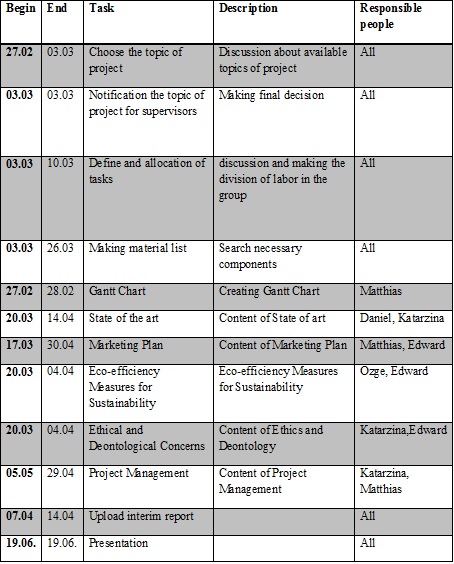 That are just the main points, all the tasks and responsibilities are shown in the Gantt-chart in the Interim Report.
7.3 Cost
To implementation of our project we received a budget of 600 €. Total cost of components, which we bought to manufacture the prototype of device is 190 €. Cost of production is not excessive, so that when we add the profit its price will be affordable and the product will be available to the wider community. The remaining funds can be useful in case of any complications or changes in during the project, when we will have to buy new materials or the use of proprietary software or services. Thanks to this reserve we will avoid budget overruns. We have also the amount of 6000 € on the marketing plan. These funds will be necessary to create advertising of our device, the spread of it and also to communicate with the clients and to maintain contact with them.
7.4 Quality
7.5 People
To work on the project have been efficient and effective, and the project was made on time, it is necessary to ensure good organization of work. Each person or institution associated with the project should be assigned the role, as well as tasks and responsibilities. The sponsor of the project is ISEP, which gave us funds to cover the costs of the project. Project implementation deals with a group of students and the supervision on it is exercised by supervisors and teachers.
Managers in particular fields:
- Team Leader- Edward
- Technical Leader- Daniel
- Sustainability Manager- Özge
- Ethics and Deontology Manager- Katarzyna
- Project Manager- Katarzyna, Matthias
- Marketing Manager-Matthias
The integration of the group, the atmosphere has a large impact on cooperation in the team therefore members of our group also spend a lot of time besides the project. Team building activities allow to better know each other, to define the role of the team and to solve the problems of communication.
7.6 Communications
Effective team communication is one of the keys to success. In our team, there are two ways of communication:
Face to face
It is very important way to communicate. Once a week or more often if it is possible we arrange meetings all members of our group. During it we discuss about each part of the project to establish goals and make decisions. Then we share tasks for everybody to work in home on their own. Even there are any problems we also solve it on our meetings.
By Internet
We have set up the group on Facebook to communicate. In case of doubt while working at home we can keep our group informed about them and receive mutual guidance. In this place we also address organizational matters and determine the appointments. Here we also share the files. For larger files we use email.
7.7 Risk
In our project are several risks which have to be identified and be managed. Our goal within the risk management is to minimize the threats and maximize the opportunities. It is important that we realize our project in the right time, in expected quality and with our calculated budget.
We did a risk brainstorming at the beginning of our project and listed up several potential risks:
- Scope is too hard to achieve; to avoid that risk we tried to be as realistic as possible
- Wrong cost forecasts; that could be a problem, because of the limited budget of our project. We planned to spend about 200€ on material, our budget is 600€ so we decided that the risk of running out of budget has a low priority and is not as relevant as the next mentioned point
- Team members are incapacitated because of for example illness; this risk can bring the project to fail, therefore we decided to have for every task in the Gantt chart one or two days extra. In addition it is possible to work at home because we can communicate via internet.
- Stakeholder conflicts; the different stakeholders have different interests and expectations to the projects so that we can have problems, therefore it is important to know what their interests are
- Lack of knowledge; it might be a problem that our team doesn`t have the necessary knowledge to perform the project and fulfill the requirements. The fact that we have no one in our team, who is an expert in programming and microelectronic, each of us had to adopt knowledge of these areas.
- Lack of knowledge; it might be a problem that our team doesn`t have the necessary knowledge to perform the project and fulfill the requirements. The fact that we have no one in our team, who is an expert in programming and microelectronic, each of us had to adopt knowledge of these areas.
- Technical problems; it might be that all electronic components aren’t compatible with each other. In addition we have to make sure that the software runs. Therefore we have to be very accurate in decision regarding the materialist
- Customer won`t buy our project; it is a risk that at the end it might be, that no one will buy the product. Possible reasons are for example, a wrong market analysis, too innovative product, too high prices, bad quality. To avoid that we have to remember that we have fulfill the customer needs and don’t look just on the technical concerns and avoid over engineering
- Procurement problems; we can have trouble when our ordered components are not delivered in the right time and right quality that would lead to a failure. To prevent that we have to order as early as possible
- Target market changed; nowadays we are living in a very fast-paced society, it could be that when we finish our project a competitor was faster and we have no chance to enter the market. We decided to do the market research not for one time but for the whole time we are working on the project
7.8 Procurement
Procurement Management is an important element of the project and involves the consideration of many aspects.
The primary decision is a choice of suppliers of components for the construction of the device. Device to satisfy our expectations should be provided with good quality materials. It is wise to use the services of a good position and opinions on the market. It is important that the ordered products arrive on time, so we should find a supplier, who ensures reliability or timeliness of delivery. We should also have in mind the location of the supplier and the type of transport, which also has an impact on delivery. We cannot afford to delay, because it would stop all the design work and resulted in failure to meet deadlines. In the case of our products all products are ordered online stores that distribute products from reputable manufacturers. Battery on www.botnroll.com, and the rest on www.inmotion.pt. With a small amount of suppliers, procurement process is less complicated and easier to plan. Due to the fact that they are online stores we communicate with them via email or telephone. Suppliers, who provide our materials are located in Portugal, so there will not be a problem with their delivery on time. It is important to be in constant contact with suppliers, because the information about the delivery of our materials will allow for further planning stages of the project and in case of problems or changes it will allow for quick reaction and action.
7.9 Stakeholders management
In our project there are several stakeholder groups. Their expectations in terms of the project are different because they are focused on various aspects. However they tend to a common goal, which is successful finish of the project. First stakeholder is ISEP, which is expected to create an innovative device. Institution gave funds for the project and provided the tools and place of work.
Second stakeholder are supervisors who wish students to during realization of this project learn and see in practice what is the scheme of creating of each project. They also want students to acquire the skills of cooperation, team communication, solving problems together and compromise. For its part, they assist us in the implementation of the project and they monitor its progress. Third group are lecturers, who mainly focus on showing us how to use the knowledge in a particular field in the project and in those which will be implemented by us in the future. For its part, each of them helps in the development of the project in terms of their competence. The last group is our team, who aim to successful finish of the project, the creation of a prototype of the device, but also to gain new experiences by working in an international environment and to learn to how create projects.
7.10 Conclusion
Project management is complex, requires time and effort. However, proper organization and scheduling, as well as their control enables an efficient and effective implementation of the project and increases the probability of success. It also neutralizes the impact of the existing limitations and risks. We should remember that the basis of each project is proper communication in the team and between all stakeholders.
8. Conclussion
8.1 Discussion
When trying to create the surf logger, we had some problems. The main one is reading and visualizing the data. We chose the option to take advantage of the AHRS firmware because our lack in knowledge about programming and the absence of time to build a program from scratch. Were also other problems like the difficulty of save the angle’s information on the SD card that would not be possible to solve without the help of the Arduino libraries. So we can conclude we would not have been able to conduct this project without the help of free software and the Arduino community.
8.2 Future Development
With our device, you can write data on SD card and can get data with Bluetooth. But it is not possible to get these data both ways. You can only use one option at a time; write on SD card or get data with Bluetooth. If we work on the possibility that use them together, we believe it can be achieved.
In the future, the device could be produced together with a surfboard manufacture. This allows us to reach the market together. Thanks to this idea, sensor box and surfboard do not have to be bought separately and the costumer doesn’t have to spend money for each one. We want to provide a product of good quality at an appropriate price. Our intention is, that the advertisement informs buyers about all the possible benefits which can be gained as a result of its use, but also about the most important technical details of the device, so that the customer will be able to determine their compliance with their requirements and make an informed choice, consistent with their expectations.
If the market research reveals an attractive market within the snowboard and skateboard industry, we will adopt our product for those markets by creating a fitted marketing plan. In addition we can increase the quality of our case regarding waterproofness by designing a deeper channel for the seal.
Furthermore we will develop a website with the issues which are already mentioned in the marketing mix.
Finally we are going to improve the erosion of the case by varnishing it with water resistant ecological paint. As a special benefit for our costumer they will be able to create their own design of the box.
Features for future would be to make the temperature sensor to make all components switch off in the event the temperature inside the case is too warm. Furthermore, to improve the visual appearance when you want to check how your surfing was. For this we could develop an app so it’s easier to watch the stats from your surf session.
Bibliography
[1] “Android Sensor Box App,” [Online]. Available: http://www.appsapk.com/android- sensor-box/. [Accessed 6 6 2014].
[2] “Supermechanical: Twine. Listen to your world. Talk to the web.,” [Online]. Available: http://supermechanical.com/twine/features.html. [Accessed 06 June 2014].
[3] “Sensor-packed SurfSens brings surfing into the computer age,” [Online]. Available: http://www.gizmag.com/sensor-packed-surfboard/18055/. [Accessed 06 June 2014].
[4] “Wearable Sensors Offer Real-Time Snowboarding Performance Stats [Future Of Gaming] - PSFK,” [Online]. Available: http://www.psfk.com/2012/01/wearable- sensors-offer-real-time-snowboarding-performance-and-stoked- readouts.html#!VvhAg. [Accessed 06 June 2014].
[5] “Inertial measurement unit,” [Online]. Available: http://en.wikipedia.org/wiki/Inertial_measurement_unit. [Accessed 06 June 2014].
[6] “Attitude and heading reference system,” [Online]. Available: http://en.wikipedia.org/wiki/Attitude_and_heading_reference_system. [Accessed 06 June 2014].
[7] “FreeIMU: an Open Hardware Framework for Orientation and Motion Sensing,” [Online]. Available: http://www.varesano.net/projects/hardware/FreeIMU. [Accessed 06 June 2014].
[8] “Specialising in embedded sensing solutions,” [Online]. Available: http://www.x- io.co.uk/. [Accessed 06 June 2014].
[9] “Accelerometer, Gyro and IMU Buying Guide,” [Online]. Available: https://www.sparkfun.com/pages/accel_gyro_guide. [Accessed 06 June 2014].
[10] “Battery (electricity),” [Online]. Available: http://en.wikipedia.org/wiki/Battery_%28electricity%29. [Accessed 06 June 2014].
[11] “Battery (electricity),” [Online]. Available: http://en.wikipedia.org/wiki/Lead%E2%80%93acid_battery. [Accessed 06 June 2014].
[12] “Nickel–cadmium battery,” [Online]. Available: http://en.wikipedia.org/wiki/Nickel%E2%80%93cadmium_battery. [Accessed 06 June 2014].
[13] “Advantages and limitations of the Different Types of Batteries,” [Online]. Available: http://batteryuniversity.com/learn/article/whats_the_best_battery. [Accessed 06 June 2014].
[14] “Nickel–metal hydride battery,” [Online]. Available: http://en.wikipedia.org/wiki/Nickel%E2%80%93metal_hydride_battery. [Accessed 06 June 2014].
[15] “Weird and Wonderful Batteries,” [Online]. Available: http://batteryuniversity.com/learn/article/weird_and_wonderful_batteries/. [Accessed 06 June 2014].
[16] “Lithium-ion battery,” [Online]. Available: http://en.wikipedia.org/wiki/Lithium- ion_battery. [Accessed 06 June 2014].
[17] “Apple - Batteries,” [Online]. Available: https://www.apple.com/batteries/. [Accessed 06 June 2014].
[18] “Advantages & Limitations of the Lithium-ion Battery,” [Online]. Available: http://batteryuniversity.com/learn/article/is_lithium_ion_the_ideal_battery. [Accessed 06 June 2014].
[19] “MIKROE-1120 mikroElektronika,” [Online]. Available: http://es.mouser.com/ProductDetail/mikroElektronika/MIKROE- 1120/?qs=yR1Mpqbr/WJ2qp8R3RI4GA==. [Accessed 06 June 2014].
[20] “What is Wifi? Webopedia.,” [Online]. Available: www.webopedia.com/TERM/W/Wi_Fi.html . [Accessed 06 June 2014].
[21] “Bluetooth Basics- Learn.,” [Online]. Available: https://learn.sparkfun.com/tutorials/bluetooth-basics/all#what-is-bluetooth . [Accessed 06 June 2014].
[22] “Bluetooth Technology,” [Online]. Available: http://imps.mcmaster.ca/courses/SE- 4C03-07/wiki/wangyv/bluetooth.html. [Accessed 06 June 2014].
[23] “RF Module,” [Online]. Available: http://en.wikipedia.org/wiki/RF_module . [Accessed 06 June 2014].
[24] “GSM/GPRS Module,” [Online]. Available: http://www.engineersgarage.com/articles/gsm-gprs-modules . [Accessed 06 June 2014].
[25] “ZigBee Alliance,” [Online]. Available: http://www.zigbee.org/Home.aspx. [Accessed 06 June 2014].
[26] “XBee Buying Guide - SparkFun Electronics,” [Online]. Available: https://www.sparkfun.com/pages/xbee_guide. [Accessed 06 June 2014].
[27] “Accelometer,” [Online]. Available: http://en.wikipedia.org/wiki/Accelerometer.
[28] “Maslow's hierarchy of needs,” [Online]. Available: http://www.21stcentech.com/wp-content/uploads/2011/10/maslow.jpg. [Accessed 06 June 2014].
[29] “Runtastic,” [Online]. Available: https://www.runtastic.com. [Accessed 17 March 2014].
[30] “Market Analysis 1,” [Online]. Available: http://www.strategyr.com/Surfing_Market_Report.asp. [Accessed 15 March 2014].
[31] “Market Analysis 2,” [Online]. Available: http://www.prweb.com/releases/surfing_surfboards/surfing_apparel/prweb8581431. htm. [Accessed 15 March 2014].
[32] “Market Analysis 3,” [Online]. Available: http://blog.euromonitor.com/2011/01/consumer-spending-sport-booming-across- age-spectrum.html. [Accessed 15 March 2014].
[33] “European Market,” [Online]. Available: http://www.worldsurfcitiesnetwork.com/index.php?page=industria-en. [Accessed 17 March 2014].
[34] “Technalia,” [Online]. Available: http://singularityhub.com/2011/03/03/check-out- the-future-of-surfing-sensors-in-the-board-record-everything-video/. [Accessed 17 March 2014].
[35] “EU population pyramids 2010 vs 2016,” [Online]. Available: http://blog.emap.com/boris/files/2012/11/demographic-change-1.jpg. [Accessed 06 June 2014].
[36] “Venture Capital,” [Online]. Available: http://www.boogar.com/resources/venturecapital/europe.htm. [Accessed 17 March 2014].
[37] “Android Sensor Box App,” [Online]. Available: http://www.appsapk.com/android- sensor-box/. [Accessed 06 June 2014].
[38] “Strategy Execution,” [Online]. Available: http://3.bp.blogspot.com/_z- _MYgLYid0/SnDHzj0a9TI/AAAAAAAAABE/mwYNdu99s80/s1600- h/Strategy_Execution.jpg. [Accessed 06 June 2014].
[39] “Sustainability Basic Information,” [Online]. Available: http://www.epa.gov/sustainability/basicinfo.htm#sustainability. [Accessed 06 June 2014].
[40] “Green Innovators of Innovation, LSIS:,” [Online]. Available: http://www.lsis.com/about/. [Accessed 06 June 2014].
[41] “U.S. Green Building Council,” [Online]. Available: http://www.usgbc.org/leed. [Accessed 06 June 2014].
[42] “ISO 14000 - Environmental management - ISO,” [Online]. Available: http://www.iso.org/iso/home/standards/management-standards/iso14000.htm. [Accessed 06 June 2014].
[43] “Program on Energy and National Security - Council on Foreign Relations,” [Online]. Available: http://www.cfr.org/projects/world/program-on-energy-and- national-security/pr1523. [Accessed 06 June 2014].
[44] “Increasing Energy Security,” [Online]. Available: http://energy.gov/articles/increasing-energy-security. [Accessed 06 June 2014].
[45] “WWF - What does WWF do?,” [Online]. Available: http://wwf.panda.org/what_we_do/. [Accessed 06 June 2014].
[46] “WWF - The Gold Standard,” [Online]. Available: http://wwf.panda.org/what_we_do/how_we_work/businesses/climate/offsetting/gold _standard/. [Accessed 06 June 2014].
[47] “TetraPak.2011.MissionPossible.SustainabilityReport,” [Online]. Available: http://www.tetrapak.com/environment/sustainability-report. [Accessed 30 May 2014].
[48] “Cork (material),” [Online]. Available: http://en.wikipedia.org/wiki/Cork_%28material%29. [Accessed 06 June 2014].
[49] “Cork in Portugal,” [Online]. Available: http://www.cork.pt/cork-industry-in- portugal.html. [Accessed 06 June 2014].
[50] “The cork industry in Portugal,” [Online]. Available: http://www.uwec.edu/geography/ivogeler/travel/portugal/cork-article2.htm. [Accessed 06 June 2014].
[51] “Rechargeable battery,” [Online]. Available: http://en.wikipedia.org/wiki/Rechargeable_battery. [Accessed 06 June 2014].
[52] “Management of fire safety in buildings in sustainable cities,” [Online]. Available: https://fenix.tecnico.ulisboa.pt/downloadFile/395144991018/Extended%20Abstract. pdf. [Accessed 06 June 2014].
[53] “adidas Group - Sustainability Reports,” [Online]. Available: http://www.adidas- group.com/en/sustainability/reporting-policies-and-data/sustainability-reports/. [Accessed 30 May 2014].
[54] “Life Cycle Assessment,” [Online]. Available: http://www.quantis- intl.com/life_cycle_assessment.php. [Accessed 06 June 2014].
[55] “Toyota Prius Life Cycle Assessment Film,” [Online]. Available: https://www.youtube.com/watch?v=CVa4GBze3tU. [Accessed 06 June 2014].
[56] “Battery (electricity),” [Online]. Available: http://en.wikipedia.org/wiki/Battery_%28electricity%29#%20Categories_and_types _of_batterie. [Accessed 06 June 2014].
[57] “Code of Ethics,” [Online]. Available: http://www.asce.org/leadership-and- management/ethics/code-of-ethics/. [Accessed 06 June 2014].
[58] “EPBA Europe - Recycling Around Europe,” [Online]. Available: http://www.epbaeurope.net/recycling.html#battery. [Accessed 06 June 2014].
[59] “Arduino UNO,” [Online]. Available: http://www.inmotion.pt/store/arduino-uno- rev-3. [Accessed 06 June 2014].
[60] “Arduino Uno,” [Online]. Available: http://arduino.cc/en/Main/ArduinoBoardUno. [Accessed 06 June 2014].
[61] “9 Degrees of Freedom,” [Online]. Available: https://www.sparkfun.com/products/10724. [Accessed 06 June 2014].
[62] “3- Axis Digital Compass IC HMC5883L,” [Online]. Available: http://dlnmh9ip6v2uc.cloudfront.net/datasheets/Sensors/Magneto/HMC5883L- FDS.pdf. [Accessed 06 June 2014].
[63] “ITG-3200 Product Specification,” [Online]. Available: http://www.sparkfun.com/datasheets/Sensors/Gyro/PS-ITG-3200-00-01.4.pdf . [Accessed 06 June 2014].
[64] “Wireless SD Shield,” [Online]. Available: http://arduino.cc/en/Main/ArduinoWirelessShield. [Accessed 06 June 2014].
[65] “RN41-XV Bluetooth Module - Chip Antenna,” [Online]. Available: https://www.sparkfun.com/products/11600. [Accessed 06 June 2014].
[66] “MC-5188 674361 2000mAh,” [Online]. Available: http://www.mouser.com/catalog/specsheets/Specification%20for%20MLP674361.pd f. [Accessed 06 June 2014].
[67] “Temperature Sensor - TMP36,” [Online]. Available: https://www.sparkfun.com/products/10988. [Accessed 06 June 2014].
[68] “I²C,” [Online]. Available: http://en.wikipedia.org/wiki/I%C2%B2C. [Accessed 06 June 2014].
[69] “TMP35/TMP36/TMP37,” [Online]. Available: http://dlnmh9ip6v2uc.cloudfront.net/datasheets/Sensors/Temp/TMP35_36_37.pdf. [Accessed 06 June 2014].
[70] “Arduino Wireless SD Shield,” [Online]. Available: http://www.bricogeek.com/shop/shields-arduino/419-arduino-wireless-sd- shield.html. [Accessed 06 June 2014].
[71] “RN42-XV Bluetooth Module,” [Online]. Available: https://www.sparkfun.com/products/11601. [Accessed 06 June 2014].
[72] “Pitch,” [Online]. Available: http://salvador-nautico.blogspot.pt/2011/09/cabeceio- pitch.html. [Accessed 06 June 2014].
[73] “DCM,” [Online]. Available: http://gentlenav.googlecode.com/files/DCMDraft2.pdf. [Accessed 06 June 2014].
[74] “Quadrotor,” [Online]. Available: http://cog.yonsei.ac.kr/quad/quad.htm. [Accessed 06 June 2014].
[75] “Right and left hand coordinate system,” [Online]. Available: http://img.my.csdn.net/uploads/201205/25/1337945764_2958.png. [Accessed 06 June 2014].
[76] “Setting up RN-42XV Bluetooth and RN-XV Wifi XBee format modules on SparkFun's FioV3 Arduino board.,” [Online]. Available: http://www.forward.com.au/pfod/ArduinoProgramming/FioV3/index.html. [Accessed 06 June 2014].
[77] “How To - Arduino and Bluetooth (RN-42),” [Online]. Available: https://www.youtube.com/watch?v=IjeIPP7dRDk. [Accessed 06 June 2014].
[78] “RN-HID-User Guide,” [Online]. Available: http://www.forward.com.au/pfod/ArduinoProgramming/FioV3/RN-HID- User%20Guide-1.1r.pdf . [Accessed 06 June 2014].
[79] “Arduino - SPI,” [Online]. Available: http://arduino.cc/en/Reference/SPI. [Accessed 06 June 2014].
[80] “Arduino - SD,” [Online]. Available: http://arduino.cc/en/Reference/SD . [Accessed 06 June 2014].
[81] “Low-power 2.4 GHz ISM-band IEEE 802.15.4 RF Transceiver with Extended Proprietary Features - RN42XV,” [Online]. Available: http://dlnmh9ip6v2uc.cloudfront.net/datasheets/Wireless/Bluetooth/RN42XV.pdf. [Accessed 06 June 2014].
[82] “ATmega48PA/88PA/168PA/328P,” [Online]. Available: http://www.atmel.com/Images/doc8161.pdf . [Accessed 06 June 2014].
[83] “TMP35_36_37,” [Online]. Available: http://inmotion.pt/documentation/sparkfun/SEN-10988/TMP35_36_37.pdf. [Accessed 06 June 2014].
[84] “ROI Import,” [Online]. Available: http://www.roi- import.com/catalog/product_info.php?manufacturers_id=115&products_id=3726. [Accessed 06 June 2014].
[85] “Low Input Voltage Synchronous Boost Converter With 1.3-A Switches,” [Online]. Available: https://www.sparkfun.com/datasheets/Prototyping/tps61200.pdf . [Accessed 06 June 2014].
[86] “LCI,” [Online]. Available: http://pl.wikipedia.org/wiki/LCI. [Accessed 06 June 2014].
[87] “Android Sensor Box App,” [Online]. Available: http://www.appsapk.com/android- sensor-box/. [Accessed 6 June 2014].